Vedic Gemstones: How a Ratna Actually Works
Learn how vedic gemstones work in Jyotish, why ratna selection needs chart analysis, and why birth month stones can mislead.
In Vedic astrology, vedic gemstones are not ordinary ornaments. A ratna is worn as an astrological remedy to strengthen the energy of a specific planet in the birth chart. This is why gemstone advice should never be casual. A beautiful ring can be chosen by taste, fashion, or budget, but a jyotish gemstone must be chosen by chart analysis. The real question is not, “Which gemstone looks good on me?” The real question is, “Which planet should be strengthened in my horoscope, and is it safe to strengthen it?”
Many people ask, “Which gemstone for me?” after reading a sun sign column, a birth month stone list, or a generic navratna chart. In classical Jyotish, that is not enough. A gemstone increases the influence of its planet. If that planet is auspicious for your lagna and weak in strength, the right gemstone may support its positive results. If the planet is harmful for your chart, strengthening it blindly can increase the very problem you are trying to solve.
What Is a Ratna in Jyotish?
The Sanskrit word ratna means gem or precious stone. In Jyotish, a ratna is used as a remedial tool. It works through the principle of strengthening the planetary vibration connected with that gemstone. This is different from using a stone only for beauty, status, or emotional comfort.
A gemstone does not “create” destiny by itself. It supports a planet that already has a role in the birth chart. The result depends on the planet’s ownership, dignity, placement, aspects, conjunctions, avastha, dasha, and overall promise of the chart.
This is why the same gemstone can help one person and disturb another. A yellow sapphire may support wisdom, children, education, and prosperity for one chart, while it may not be suitable for another chart if Jupiter functions as a difficult planet. A blue sapphire may give discipline and progress to one native, but pressure and obstacles to another if Saturn is not favourable.
Navratna: The Nine Planetary Gemstones
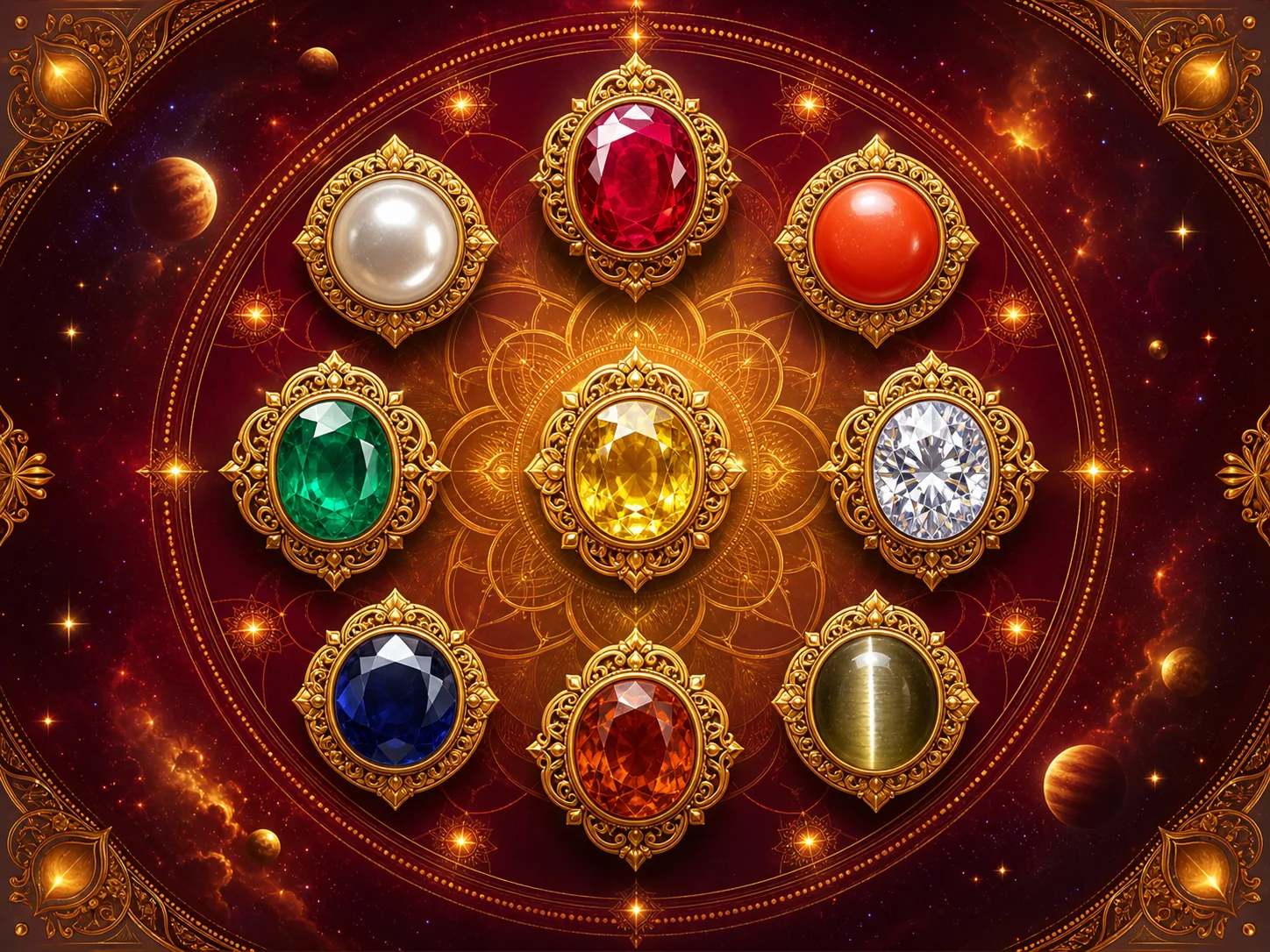
The classical navratna system connects nine gemstones with the nine grahas used in Jyotish. These are not random colour associations. Each gem is linked to a planetary force.
| Planet | Gemstone | Common Sanskrit or Hindi Name |
|---|---|---|
| Sun | Ruby | Manikya |
| Moon | Pearl | Moti |
| Mars | Red coral | Moonga |
| Mercury | Emerald | Panna |
| Jupiter | Yellow sapphire | Pukhraj |
| Venus | Diamond | Heera |
| Saturn | Blue sapphire | Neelam |
| Rahu | Hessonite | Gomed |
| Ketu | Cat’s eye | Lehsunia |
These nine gems are often seen together in a navratna ring or pendant. However, wearing all nine together is not automatically suitable for everyone. A navratna ornament is a traditional sacred design, but from a remedial perspective, the astrologer must still consider whether strengthening all nine planetary forces is desirable in that person’s chart.
How Vedic Gemstones Actually Work
A gemstone is understood to strengthen its associated planet. This is the most important rule. Gemstones are not used to “calm down” a planet in the way charity, mantra, vrata, or seva may be used for pacification. A gemstone increases the planet’s capacity to deliver results.
For example:
- Ruby strengthens the Sun, including authority, confidence, father, vitality, and leadership.
- Pearl strengthens the Moon, including mind, emotional stability, mother, fluids, and public connection.
- Red coral strengthens Mars, including courage, land, action, blood, stamina, and siblings.
- Emerald strengthens Mercury, including speech, intellect, trade, learning, and calculation.
- Yellow sapphire strengthens Jupiter, including wisdom, children, dharma, teachers, wealth, and grace.
- Diamond strengthens Venus, including comfort, marriage, beauty, vehicles, art, and luxury.
- Blue sapphire strengthens Saturn, including discipline, work, patience, endurance, and long term karma.
- Hessonite strengthens Rahu, including ambition, unconventional success, foreign influence, and worldly drive.
- Cat’s eye strengthens Ketu, including detachment, moksha, sharp intuition, and spiritual perception.
Because the gemstone strengthens the planet, the first question is simple: should this planet be strengthened for this chart?
Why Birth Month Gemstones Can Mislead
Birth month gemstone systems are popular because they are easy to remember. January has one stone, February another, and so on. But Jyotish does not prescribe a gemstone merely from the calendar month of birth.
Even the Sun sign alone is not enough. In Indian astrology, the lagna, Moon sign, planetary lordships, dasha, and full kundli are more important than a general monthly category. Two people born in the same month can have completely different ascendants, Moon signs, dashas, and planetary strengths.
For example, two people may both be born in April. One may have Leo lagna, where the Sun has a special role as lagna lord. Another may have Libra lagna, where the Sun owns the eleventh house and may not be the first choice for strengthening. The same ruby advice cannot be given to both simply because of a month.
This is why the correct Jyotish approach begins with a properly calculated birth chart. You can generate a free kundli first, then consult a qualified astrologer for interpretation before wearing a ratna.
Functional Benefic: The Key to Gemstone Selection
In Parashari Jyotish, planets are not judged only as naturally benefic or naturally malefic. They are also judged by functional role for a particular lagna.
Natural benefics include Jupiter, Venus, Mercury when unafflicted, and a bright Moon. Natural malefics include Saturn, Mars, Sun, Rahu, Ketu, and a dark Moon. But for gemstone selection, functional beneficence is crucial.
A planet becomes functionally benefic when it owns auspicious houses for a particular ascendant, especially trikonas such as the 1st, 5th, and 9th houses. A planet may become functionally difficult when it owns dusthanas such as the 6th, 8th, or 12th houses, or when its lordship and placement create problems.
A gemstone is generally considered for a functional benefic that is weak, afflicted, combust, debilitated, poorly placed, or unable to deliver its promise fully. The aim is to strengthen a helpful planet, not to empower a harmful one.
A Simple Example
For Aries lagna, Mars rules the 1st house and the 8th house. Because Mars is the lagna lord, it has an important protective role, but the 8th lordship must also be considered carefully. Red coral may be useful in many Aries charts, but not blindly. If Mars is severely afflicted, placed in a sensitive condition, or connected with harmful combinations, the astrologer must judge carefully.
For Taurus lagna, Saturn rules the 9th and 10th houses, becoming a powerful yogakaraka. In such charts, blue sapphire may be considered if Saturn is favourable but weak. Still, the stone should be tested and prescribed with care.
This is why gemstone advice cannot be reduced to one sentence.
What an Astrologer Checks Before Recommending a Gemstone
A responsible astrologer does not ask only your birth date and then prescribe a stone. The full chart must be examined. Important factors include:
- Lagna and lagna lord strength
- House ownership of the planet
- Placement by sign and house
- Exaltation, debilitation, own sign, friendly sign, or enemy sign
- Combustion, retrogression, planetary war, and affliction
- Aspects and conjunctions
- Navamsha and other divisional charts where relevant
- Running dasha and antardasha
- Current gochar or transit support
- The actual life problem for which the remedy is being considered
A gemstone should match the chart and the purpose. Someone seeking marriage harmony may need a very different analysis from someone seeking career stability, health support, education, or spiritual discipline.
Why Blue Sapphire and Red Coral Need Extra Care
All gemstones should be chosen carefully, but blue sapphire and red coral deserve special caution.
Blue Sapphire, Neelam
Blue sapphire strengthens Saturn. Saturn is slow, intense, karmic, and result oriented. When Saturn is favourable, blue sapphire may support discipline, career progress, patience, structure, and long term stability. When Saturn is unfavourable or badly placed, strengthening it may increase delay, pressure, loneliness, fear, fatigue, or professional burden.
This is why many astrologers recommend testing blue sapphire before wearing it permanently. The testing method, duration, and final decision should be guided by the astrologer, not by superstition or panic.
Red Coral, Moonga
Red coral strengthens Mars. Mars gives courage, action, property, energy, and protection. But Mars can also increase aggression, heat, conflict, injuries, impatience, and impulsive decisions if wrongly strengthened.
For people with strong anger, blood pressure tendencies, marital conflict, or accident prone patterns, red coral must be judged carefully. It is not a simple “confidence stone” for everyone.
Metal, Finger, Weight, Day, and Energising
Many people focus only on the stone name, but in Jyotish the method of wearing also matters. The metal, finger, weight, day, mantra, and energising ritual are usually decided according to the planet and the individual chart.
Common traditional associations are known, such as gold for Jupiter and Sun, silver for Moon, copper for Mars, and iron or panchadhatu in some Saturn related practices. But these are not universal prescriptions. A qualified astrologer may adjust the recommendation based on the chart, tradition followed, availability, and the purpose of the remedy.
The same applies to:
- Finger or pendant placement
- Minimum weight or carat
- Natural versus treated gemstone
- Day and hora for wearing
- Mantra japa before wearing
- Pran pratishtha or energising ritual
- Whether the gem should touch the skin
The ritual is not merely decorative. It aligns intention, mantra, purity, and planetary invocation. Still, ritual cannot make a wrongly chosen gemstone suitable. Correct selection comes first.
Natural, Treated, and Substitute Stones
In remedial Jyotish, quality matters. A stone used as a remedy should ideally be natural, untreated, clear enough, and suitable for wearing. Very poor quality, synthetic, heavily treated, cracked, or dull stones may not be preferred for astrological use.
However, not everyone can afford expensive gems. In some cases, substitutes are considered, such as citrine or yellow topaz for yellow sapphire, or peridot for emerald. The use of substitutes depends on the astrologer’s tradition and the strength of the remedial need. A substitute is usually considered milder than the main gemstone.
Do not assume that bigger is always better. A large gemstone for the wrong planet is not a stronger remedy, it is a stronger mistake.
Gemstones Are Not a Replacement for Karma
A mature approach to Jyotish never treats gemstones as magic buttons. A ratna may support a planet, but it does not replace right action, discipline, prayer, medicine, financial planning, communication, or ethical conduct.
For example, a gemstone for career cannot replace skill building. A gemstone for marriage cannot replace patience and honest communication. A gemstone for health cannot replace medical care. Remedies work best when they support sincere effort.
This is why classical remedial practice includes not only ratna, but also mantra, daan, vrata, seva, yantra, worship, and self correction. In many charts, a mantra or charity remedy may be safer than a gemstone, especially when the planet should be pacified rather than strengthened.
“Which Gemstone for Me?” The Right Way to Ask
Instead of asking only, “Which gemstone for me?”, ask more precise questions:
- Which planets are functional benefics for my lagna?
- Which of those planets are weak and need strengthening?
- Is the planet connected to the life area I want to improve?
- Is the dasha supporting the use of that gemstone now?
- Are there any risks in strengthening this planet?
- Should I use a gemstone, mantra, daan, or another upaya?
This is the difference between casual gemstone shopping and real Jyotish remedy selection. If your concern is marriage, compatibility, or family life, chart matching and deeper analysis may be more relevant than simply wearing Venus or Jupiter stones. You can also explore kundli matching where appropriate.
When You Should Avoid Wearing a Gemstone Blindly
You should be especially cautious if:
- Someone recommends a stone only from your birth month
- A shopkeeper suggests a costly gem without chart analysis
- The advice is based only on your Sun sign
- You are told that everyone can wear navratna safely
- You are advised to wear blue sapphire without testing
- You are advised to wear multiple powerful stones together
- You are going through a difficult dasha and want a quick fix
- You have already reacted badly after wearing a stone
A wrong gemstone may not always create dramatic events, but it can increase restlessness, conflict, expenses, emotional heaviness, aggression, sleep disturbance, or obstacles connected with that planet. If you feel uncomfortable after wearing a new stone, remove it and consult an astrologer.
For personalised guidance, it is always wiser to talk to an astrologer before investing in a costly ratna.
Frequently Asked Questions
1. Are vedic gemstones the same as birthstones?
No. Birthstones are usually based on the month of birth. Vedic gemstones are selected by analysing the kundli, especially the lagna, planetary lordship, strength, dasha, and the purpose of the remedy.
2. Can I wear a gemstone for a planet that is troubling me?
Not always. A gemstone strengthens its planet. If a planet is functionally harmful, strengthening it may increase its difficult results. For troubling planets, mantra, daan, vrata, or other pacifying remedies may be better.
3. Which gemstone is best for money?
There is no single wealth gemstone for everyone. Jupiter, Venus, Mercury, Moon, or the lord of the 2nd, 9th, or 11th house may be relevant depending on the chart. The correct gemstone depends on your horoscope.
4. Is blue sapphire dangerous?
Blue sapphire is not “bad” by itself. It strengthens Saturn. If Saturn is favourable, it may be very supportive. If Saturn is unfavourable, it may intensify pressure. That is why it should be tested and prescribed carefully.
5. Can I wear navratna jewellery?
Navratna jewellery has traditional value, but from a remedial Jyotish view, wearing all nine planetary gems may not be suitable for every chart. It is better to consult an astrologer before wearing it as a remedy.
6. How long does a gemstone take to work?
There is no fixed rule for everyone. Some people notice changes quickly, while for others the effect is gradual. Results depend on the planet’s promise in the chart, dasha, strength of the stone, and the sincerity of the accompanying effort.
Final Thoughts
Vedic gemstones are sacred remedial tools, not fashion accessories. A ratna should be worn only after understanding which planet it strengthens and whether that planet is truly beneficial for your chart. The right gemstone can support a weak functional benefic, but the wrong gemstone can strengthen a problem.
The safest rule is simple: never wear a jyotish gemstone blindly by birth month, Sun sign, or hearsay. Begin with your kundli, understand the planet, check the dasha, and take guidance from a qualified astrologer. In Jyotish, wisdom is not in wearing the most expensive stone. Wisdom is in strengthening the right planet at the right time, in the right way.