Combustion in Vedic Astrology: When a Planet Nears the Sun
A combust planet is obscured by the Sun, not erased. Learn how degree distance, dignity, house rulership, divisional charts and dasha shape its results.
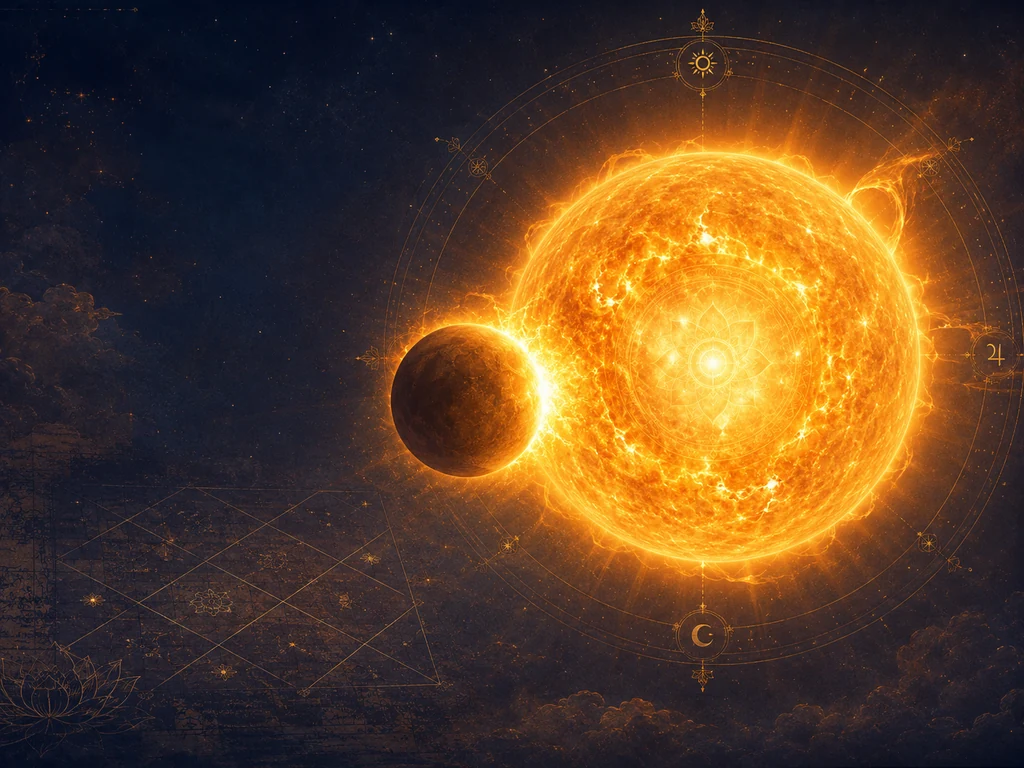
When a planet sits too close to the Sun, it becomes combust: its light is hidden, and its ability to express its significations freely is reduced. It is not destroyed, cancelled or automatically made malefic. In practice, combustion shows that the planet must work through the Sun’s agenda—authority, identity, visibility, will and ego—so its results become more concentrated, pressured, private or dependent on recognition.
The Sanskrit term is astangata, literally “set” or no longer visibly risen. That astronomical image matters. The planet still exists and retains its sign, house ownership, aspects and divisional-chart condition, but it cannot be read as though it were operating in open sky.
What does planetary combustion actually mean?
Combustion is measured by the planet’s zodiacal longitude from the Sun, not merely by whether the two appear in the same sign. A planet may therefore be combust across a sign boundary. If the Sun is at 29° Pisces and Mercury is at 2° Aries, the shortest separation is only 3°, so Mercury is very close to the Sun even though the sign labels differ.
The classical idea is visibility. A planet approaching the Sun disappears into solar glare, remains hidden for a period, then eventually emerges. Jyotisha translates that loss of visibility into diminished independent agency. Mercury may know the answer but speak only after approval. Venus may desire harmony yet bend excessively around status or pride. Jupiter may hold sound judgement but struggle to be heard by powerful people. The exact manifestation depends on the chart.
Brihat Parashara Hora Shastra gives working limits for planetary setting, while editions and lineages differ slightly in a few values. The commonly used Parashari ranges are about 12° for the Moon, 17° for Mars, 14° for direct Mercury and roughly 12° when retrograde, 11° for Jupiter, 10° for direct Venus and roughly 8° when retrograde, and approximately 15°–16° for Saturn. The closer the conjunction, the more seriously a practitioner weighs it.
These are thresholds, not on-off switches. Mercury 13° from the Sun and Mercury 1° from it may both qualify, but the tighter conjunction deserves more weight.
“A combust planet is not absent from the chart; it is a planet whose voice must pass through the Sun before it reaches the world.”
Why does the Sun weaken a nearby planet?
The Sun represents the central principle of selfhood: vitality, rank, conscience, authority, father figures, government and the need to stand as an individual. A nearby planet enters that intense field. Symbolically, the Sun can overexpose the planet’s function.
This can look like high ability with limited ease. A combust Mercury may think sharply yet speak defensively; combust Mars may act bravely but react to wounded pride; combust Venus may show refined taste while making affection vulnerable to validation. The planet’s functions have reduced autonomy: the Sun absorbs, redirects or dominates them.
Phaladeepika classifies a combust planet as Vikala, a distressed condition, and contrasts it with a planet able to shine clearly. Yet the same text, like other classical works, repeatedly assesses strength through several factors rather than one isolated condition. Sign dignity, house placement, benefic influence and the condition of the relevant house lord still matter. A serious reading follows that layered method rather than turning one conjunction into a verdict.
How do you read a combust planet in a birth chart?
Begin with the exact separation. Calculate the shortest angular distance between the Sun and the planet. Do not stop at “conjunct.” A conjunction of 9° is not equivalent to 50 minutes of arc.
Next, judge the planet’s sign dignity. A planet in its own sign, exaltation sign, moolatrikona or a supportive friend’s sign has resources that a debilitated or enemy-sign planet lacks. Combustion can obstruct delivery without erasing underlying competence. This distinction is especially important when a planet is both dignified and combust: the person may possess the capacity but need maturity, timing or the right environment to express it.
Then inspect the Sun. A stable, well-placed Sun may channel the nearby planet into leadership, public responsibility or disciplined purpose. A severely afflicted Sun can make the conjunction more volatile because both planets become involved in insecurity, status conflict or poor judgement. Read the Sun’s house lordship for the ascendant, its sign, its aspects and its dispositor.
House ownership is the next decisive layer. A combust planet carries the houses it rules into the solar conjunction. For a Virgo ascendant, Mercury rules the first and tenth houses; its combustion can affect identity, health routines, career voice and professional decision-making. For a Taurus ascendant, Mercury rules the second and fifth; the focus shifts toward speech, money, learning, children, counsel and creative intelligence.
Then read the occupied house. A combust tenth lord in the third may work through communication and enterprise; in the twelfth, through institutions, foreign settings, research or hidden labour. See how to read a janam kundli house by house for the placement framework.
Finally, check the Navamsa and relevant divisional charts. A well-placed divisional counterpart can support maturation; weakness across charts calls for greater conscious management. Divisional charts do not cancel combustion.
Does a combust planet lose all of its good results?
No. It may lose ease, visibility or independence, but not necessarily talent, status or outcome. This is one of the most important corrections to popular astrology.
Suppose Mercury is combust in Virgo, its own and exaltation sign. Mercury is highly capable by sign but constrained by proximity to the Sun. The native may be analytically gifted, technically exact and excellent at diagnosis, editing or calculation. The friction may appear as overthinking, harsh self-review, difficulty delegating or a professional identity tied too tightly to being intelligent.
Likewise, a combust Venus in Libra does not prove failed relationships. It can show genuine refinement and social intelligence, yet relationships may become the arena where pride, approval, public image or unequal attention must be worked through. A supportive seventh lord, benefic aspects and a strong Navamsa can substantially change the outcome.
An own-sign placement does not make combustion disappear. Strength and affliction can coexist: the chart may promise capacity and pressure at once.
What does each combust planet tend to show?
Combust Mercury often concentrates the mind. Speech, commerce, writing, analysis, memory and negotiation become closely tied to identity or authority. Because Mercury naturally remains near the Sun, combustion is common and should never be judged dramatically. The closest conjunctions deserve more attention, especially when Mercury rules important houses or is weak elsewhere.
Combust Venus may internalise affection, pleasure and artistic judgement. Relationship choices can become influenced by family honour, appearance, status or the wish to preserve peace. Venus’s sign, the seventh house and the Navamsa marriage chart decide whether this becomes refinement, sacrifice or frustration.
Combust Mars can place action under the command of pride, duty or competition. The person may act bravely but react badly to being ignored. In constructive charts it supports disciplined leadership, engineering, surgery, sport or decisive work. In afflicted charts it can produce overheated conflict, especially during Mars-Sun periods.
Combust Jupiter can make wisdom sincere but less publicly influential. Mentors may be dominant or difficult to satisfy, while beliefs are revised through clashes with authority. Results for children, education, wealth and counsel depend on Jupiter’s rulership and dignity.
Combust Saturn places labour, boundaries and fear near the solar demand for command. It can produce a serious worker carrying responsibility without recognition, or alternating between submission and resistance to authority. A strong Saturn still builds lasting results through patience.
The Moon is a special case. Nearness to the Sun creates a dark Moon around amavasya, reducing reflected light and often increasing inwardness, subjectivity or emotional dependence on the solar principle. Many practitioners discuss this through lunar phase and paksha strength rather than treating it exactly like combustion of the visible planets. Rahu and Ketu are not combust in the ordinary sense; as shadow points, they participate in eclipses rather than losing visibility like physical planets.
Worked example: Is exalted Mercury still weak when combust?
Consider a Taurus ascendant with the Sun at 20° Virgo and Mercury at 24° Virgo in the fifth house. Their separation is 4°, placing Mercury well within the commonly used combustion range. Mercury is also in Virgo, where it is in its own sign and exaltation sign, and it rules the second and fifth houses for Taurus ascendant.
Two shortcuts fail here: “Mercury is exalted, so everything is excellent,” and “Mercury is combust, so education is ruined.” Neither is good jyotisha.
The correct reading preserves both facts. Mercury has high competence: discrimination, language, calculation, pattern recognition, study and advisory capacity can be strong. Because it rules the second and fifth houses and sits in the fifth, education, speech, finance, memory, children, authorship and strategic thinking become central life themes. The placement can support teaching, analysis, accounting, medicine, coding, editing or market research.
Combustion changes how the promise is delivered. The person may identify strongly with being knowledgeable and feel unusually exposed when corrected. Speech can become precise but overly controlled. Creative work may remain private until it meets an exacting standard. Decisions about children or education may be shaped by prestige, the father’s expectations or the need to prove competence.
The Sun is the fourth lord for Taurus ascendant, so home, mother, property, formal education and emotional security also enter the fifth-house conjunction. This can describe a highly academic home, a parent who directs educational choices, or learning pursued partly to secure respect. It does not establish any single event by itself.
Before final judgement, I would inspect Mercury’s Navamsa dignity, aspects to Virgo, Venus as ascendant lord and the operating dasha. Strong divisional support may turn combustion into pressure and perfectionism more than denial; repeated weakness can produce clearer obstacles in education, speech or judgement.
This example shows the core principle: dignity describes capacity; combustion describes impaired independence of expression.
When does combustion become active in timing?
A natal combust planet is present throughout life, but it becomes louder during its mahadasha, antardasha or other relevant period. The Sun’s period can also activate the conjunction because the Sun carries the nearby planet’s themes. To understand the timing framework without repeating it here, read Vimshottari dasha and why timing matters.
Transits temporarily combust planets as they approach the Sun. Their personal importance depends on the houses involved and whether the transit activates a sensitive natal point or dasha lord.
For electional work, many traditions avoid launching matters governed by a planet while it is deeply combust, especially when that planet is essential to the undertaking. A marriage election weighs Venus and Jupiter; a commercial agreement weighs Mercury. Yet electional judgement also considers the Moon, ascendant, tithi, weekday and the full Panchang. One combustion condition does not replace the complete muhurta.
Because combustion dates change every year and differ by planet, there is no single “2026 combustion season.” Exact ingress, retrograde and visibility dates should be calculated from a reliable sidereal ephemeris for the location and ayanamsha being used.
What should you do about a combust planet?
First, do not treat it as a defect requiring panic. The practical task is to give the planet a cleaner channel that does not depend entirely on praise, rank or external approval.
For Mercury, write before speaking and build decision systems. For Venus, separate affection from social image. For Mars, prefer disciplined effort and delayed reaction to suppression. For Jupiter, test belief through lived ethics. For Saturn, practise clear boundaries and patience.
Traditional remedies are best chosen from the whole chart. Simple, non-commercial practices such as sunrise discipline, respectful conduct toward mentors and parents, charity connected with the planet’s significations, mantra within one’s tradition and consistent ethical behaviour are generally safer than impulsively wearing a gemstone. A gemstone can amplify a planet’s house lordship as well as its natural significations; it should not be prescribed from combustion alone. A personalised kundli analysis is appropriate when several conditions interact.
What are the biggest myths about combust planets?
The first myth is that every Sun conjunction destroys the other planet. It does not. Close separation matters, and the planet retains sign dignity, house rulership and divisional strength.
The second myth is that the conjunction must occur within one sign. Combustion is based on longitude, so cross-sign combustion is possible.
The third myth is that a named yoga automatically cancels combustion. A Sun-Mercury conjunction may contribute to Budha-Aditya themes of intellect, administration or speech, but the exact degrees still matter. Yoga and affliction can operate together.
The fourth myth is that combust Mercury is rare or catastrophic. Mercury never travels far from the Sun, so close solar contact is common. A practitioner must distinguish ordinary proximity from an extremely tight conjunction and then judge Mercury’s full condition.
The fifth myth is that combustion guarantees failure in marriage, career, children or wealth. Such claims ignore house strength, dispositor, aspects, divisional charts and dasha. Classical rules are conditional. They are not permission to frighten a client.
Frequently asked questions about combustion
Is a planet at the same degree as the Sun always worse?
Usually the closer the longitude, the stronger the combustion effect, but “worse” is too crude. An exact conjunction can produce intense focus, identification and exceptional concentration along with reduced objectivity. Sign strength and house function decide what that intensity does.
Can a retrograde planet be combust?
Yes. Retrograde motion does not automatically protect a planet from solar proximity. Some classical working ranges are modified for retrograde Mercury and Venus, and editions vary in details. Use one coherent calculation standard rather than switching values to obtain a preferred answer.
Does exaltation cancel combustion?
No. Exaltation gives strength of capacity and placement; combustion reduces independent expression. An exalted combust planet can be talented, important and productive while still operating under pressure.
Is combustion the same as planetary war?
No. Combustion is proximity to the Sun and loss of visibility. Planetary war concerns close longitude between certain non-solar planets and is judged by separate rules. They should not be merged.
Can a combust planet improve with age?
Its natal condition does not disappear, but expression can improve through maturity, supportive dashas, stronger divisional indications, training and conscious behaviour. What begins as dependence on authority may become the ability to work responsibly with power.
When should I not worry about combustion?
Do not worry merely because software prints the word “combust.” Concern is lower when the separation is near the outer limit, the planet has strong dignity, its dispositor is stable, benefic support is present, divisional charts are sound and relevant life areas are functioning well. Even deep combustion is a pattern to understand, not a sentence.
The chart must be read as an ecosystem. Combustion tells us that one planetary function stands very near the solar centre; it does not tell us the whole life. Astrology is best used for guidance and reflection, not as a substitute for medical, legal or financial advice.
Classical-source verification for the combustion ranges and Vikala classification: