Gandanta: Water–Fire Knots and the Souls Born Within
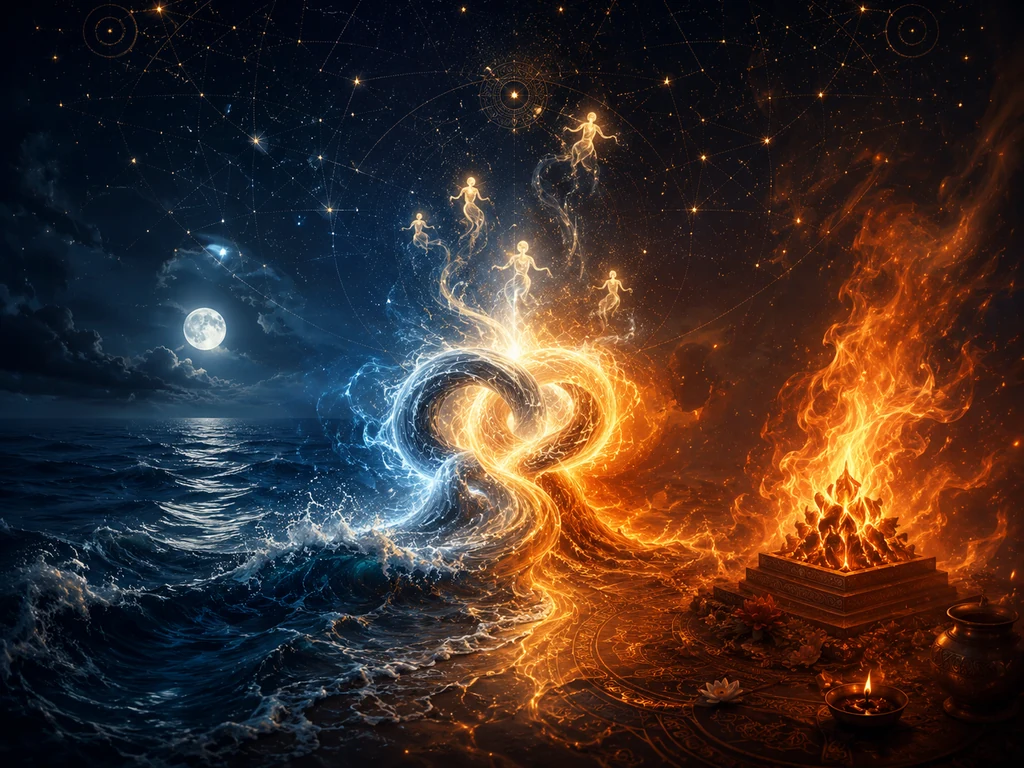
Gandanta is the sensitive junction where water signs end and fire signs begin, marking concentrated transitions—not a verdict of doom—in a birth chart.
What does gandanta mean in Vedic astrology?
Gandanta means an “end-knot” or a knot at a boundary. In practical Jyotisha, it refers to the three places where a water sign ends and a fire sign begins: Pisces to Aries, Cancer to Leo, and Scorpio to Sagittarius. These are also nakshatra boundaries—Revati to Ashwini, Ashlesha to Magha, and Jyeshtha to Mula—so the transition occurs in both the sign zodiac and the lunar mansion framework.
That double change is the real reason the placement matters. A planet is not merely changing signs; it is leaving one nakshatra field and entering another at the same point. The old container has ended, while the new one has barely acquired form. Gandanta therefore describes concentrated transition, not guaranteed misfortune.
The phrase “souls born inside the knot” is poetic rather than a separate classical category. It points to a recognisable pattern: an ending must often be completed before a clean beginning becomes possible. Whether this appears as family change, inner restlessness, unusual maturity, or decisive turning points depends on the whole kundli.
Why are water-to-fire junctions treated as knots?
Water receives, contains, remembers, and dissolves. Fire separates, illuminates, initiates, and gives direction. At a water-fire junction, the chart moves from a field that gathers experience into one that must act upon it. The symbolism is not that water and fire are “enemies” in a simplistic sense, but that their modes of operation are difficult to blend without transformation.
The three knots also arrive at the ends of different cycles. Pisces to Aries closes the zodiac and starts it again. Cancer to Leo moves from private belonging and emotional containment toward visibility, authority, and self-expression. Scorpio to Sagittarius moves from secrecy, entanglement, survival, and depth toward meaning, principle, teaching, and a wider horizon.
This is why two people with gandanta placements can look entirely different. One may be born into a family changing homes or responsibilities; another may struggle with closure; a third may become highly capable at guiding others through change. The knot names the threshold, while the planet, house, dignity, and timing describe the story.
“Gandanta does not cancel a chart; it concentrates unfinished business at a threshold where one pattern must end before another can begin.”
Where exactly are the gandanta degrees?
This is the first place where careful astrologers distinguish classical wording from modern shorthand. In Chapter 92, the Brihat Parashara Hora Shastra describes nakshatra gandanta through time portions: the last two ghatikas of Revati and first two of Ashwini, the last two of Ashlesha and first two of Magha, and the last two of Jyeshtha and first two of Mula. It separately gives a narrower half-ghatika measure for lagna gandanta at the corresponding sign junctions.
A ghatika is a unit of time, not a degree of longitude. For that reason, lineages do not all convert the rule identically. Some practitioners calculate the actual temporal interval from a panchanga. Others use a narrow fixed zodiacal screen, commonly about 0°48′ on either side of the exact boundary. A broader teaching convention treats the final pada of the water nakshatra and the first pada of the fire nakshatra—3°20′ on each side—as a zone of transition.
These approaches should not be mixed carelessly. The full pada is useful for noticing a theme but too broad to declare an acute affliction. In consultation, I record both the broad zone and the exact distance from 30°00′/0°00′. Proximity determines weight.
Thus the broad Revati-Ashwini zone runs from the last pada of Pisces into the first pada of Aries. The same pattern applies to Ashlesha-Magha at Cancer-Leo and Jyeshtha-Mula at Scorpio-Sagittarius. But a Moon at 27°10′ Cancer and a Moon at 29°55′ Cancer should not be read as equally intense merely because both occupy Ashlesha’s fourth pada.
Is every Ashlesha, Jyeshtha, Revati, Magha, Mula, or Ashwini birth gandanta?
No. This is one of the most common errors in popular astrology. The six nakshatras touch the three gandanta points, but their entire spans are not automatically gandanta. A person born in Magha’s third pada, for example, is far from the Cancer-Leo boundary.
The label “gand mool” is also often applied so broadly that it becomes clinically useless. A responsible reading begins with the exact sidereal longitude of the Moon and ascendant, the ayanamsa used, and the reliability of the birth time. A difference of several minutes in recorded birth time can move the ascendant materially, while the Moon usually changes more slowly but can still shift enough to alter a close boundary judgement.
Before interpreting a child’s chart, verify the calculation through a reputable ephemeris or daily panchang. Never frighten parents from a nakshatra name alone.
How do you read gandanta in a birth chart?
Begin with the body that is actually near the junction. The Moon describes the mind, emotional regulation, felt security, mothering environment, and the starting point of Vimshottari dasha. The ascendant describes embodiment and the manner in which life is entered. The ascendant lord carries the chart’s practical agency. The Sun can show identity, authority, vitality, and father-related themes. Other planets bring their natural significations and house lordships into the knot.
Next judge the planet’s house. A gandanta planet in the fourth may concentrate transitions around home, education, property, emotional foundations, or the maternal field. In the seventh, the pattern can appear through partnership, contracts, public dealings, or repeated renegotiation of relational boundaries. In the tenth, it may describe abrupt professional reinvention or work that sits between systems.
Then judge both controllers of the placement. The sign lord tells us whether the planet has a stable dispositor capable of carrying it forward. The nakshatra lord tells us how the experience is processed and often connects the placement to dasha timing. A strong, well-placed dispositor can turn raw instability into competence. A weak or heavily afflicted dispositor may leave the native repeating the same transition without integration.
Dignity, combustion, retrogression, aspects, shadbala, and repetition in divisional charts all matter. Phaladeepika and Saravali, like the wider Parashari method, modify results by strength, placement, and association. A repeated boundary theme in the birth chart and navamsha deserves more weight than one broad-pada contact.
A Jaimini layer can add context when the planet is the Atmakaraka or strongly tied to the karakamsha, but that does not create a separate verdict. It should be judged through the full Jaimini framework—rashi aspects, sign strength, karakas, and the relevant sign dasha—rather than attaching “soul trauma” to one longitude.
What changes when the Moon is in gandanta?
The Moon is the most discussed gandanta placement because the Moon anchors the birth nakshatra and the Vimshottari sequence. Its location therefore describes both an emotional threshold and a timing threshold.
When the Moon is at the very end of Revati, Ashlesha, or Jyeshtha, only a small portion of the ruling planet’s mahadasha remains at birth. A major dasha change may occur in infancy or early childhood, when the child experiences events through the family system rather than through conscious choice. When the Moon has just entered Ashwini, Magha, or Mula, most of the new nakshatra lord’s period remains. The person begins life inside a freshly opened dasha current.
The water side often emphasises completion or release; the fire side, initiation before the person feels prepared. These are tendencies, not deterministic rules.
Readers who need the timing mechanics can use the separate Vimshottari dasha guide rather than treating gandanta as a substitute for dasha analysis.
Worked example: Moon at 29°32′ Scorpio
Consider a Taurus ascendant with the Moon at 29°32′ Scorpio in the seventh house. The Moon is in Jyeshtha, fourth pada, only 0°28′ from the Scorpio-Sagittarius junction. It falls inside the broad final-pada zone and also inside a narrow 0°48′ working screen. This is a genuine close gandanta placement, not merely a Jyeshtha birth.
The house directs the knot toward partnership, agreements, and trust. The Moon also rules the third house for Taurus ascendant, linking communication, siblings, courage, and skills. The Moon is debilitated by sign, but its deepest debility degree is much earlier in Scorpio; support must still be assessed.
Now add two stabilising facts. Suppose Mars, lord of Scorpio, is exalted in Capricorn in the ninth house, while Mercury, lord of Jyeshtha, is strong in Virgo in the fifth. The Moon itself is knotted, but both the sign lord and nakshatra lord have the capacity to organise its results. This native may still encounter powerful relationship transitions, yet can develop unusual skill in mediation, analysis, teaching, counselling, or managing complicated agreements. The placement becomes demanding, not barren.
The dasha balance makes the example concrete. Jyeshtha spans 13°20′, or 800 arcminutes. At 29°32′ Scorpio, only 28 arcminutes remain. The remaining fraction is 28/800. Applied to Mercury’s seventeen-year Vimshottari period, that leaves roughly 0.595 years—about seven months—of Mercury mahadasha at birth. Ketu mahadasha begins in infancy. An astrologer would therefore ask about changes in the family’s circumstances during the first year, while avoiding the lazy assumption that a dramatic event must have occurred.
Later activation would be sought in periods of the Moon, Mars, Mercury, Ketu, the seventh-house network, or planets closely influencing 29°32′ Scorpio. The worked judgement comes from the chain of evidence, not from the word gandanta alone.
When does gandanta become active?
A natal knot is most audible when its planet’s mahadasha or antardasha runs, when the sign lord or nakshatra lord becomes active, or when transits contact the exact natal degree. Periods involving the houses occupied and ruled by the planet can also bring the theme forward. The event may be external, such as a relocation or contract ending, or internal, such as finally releasing an identity that has outlived its purpose.
Slow transits deserve attention because they remain near the boundary longer, but an ingress is not automatically harmful. In 2026, Jupiter enters Cancer on 2 June in a swift atichara passage and enters Leo on 31 October, crossing the Cancer-Leo gandanta. This is a collective transit marker, but it becomes personally important only when it contacts sensitive natal degrees, relevant houses, or an operating dasha.
Ketu enters Cancer on 26 November 2026 by the true-node calculation, crossing the same Leo-Cancer boundary in reverse. Mean-node almanacs may place the shift in early December. Because nodes move retrograde, the psychological symbolism can feel like revisiting or detaching from a recently established Leo-type agenda of visibility, authority and self-expression. Exact ingress times and local calendar details should be checked through the panchang, especially for electional work.
What should someone born in gandanta actually do?
First, verify the chart. Use a consistent sidereal ayanamsa, a reliable birth time, and exact longitudes. Rectification may be necessary when the ascendant is close to the boundary. A generic online label is not enough.
Second, identify the life area rather than worshipping the diagnosis. Ask what the planet signifies, which houses it rules, where its dispositor sits, and what repeatedly happens at beginnings and endings. The practical remedy is often behavioural: learning to close agreements clearly, completing grief, setting boundaries before a fresh commitment, building continuity during relocation, or refusing to begin a new chapter while the old one remains administratively open.
Classical Parashari chapters prescribe shanti rites, worship, abhisheka, homa, and charity for gandanta births. These belong to a ritual culture and should be approached proportionately, voluntarily, and through a competent priest—not sold through fear. Simple prayer, charity connected to the planet’s significations, service, and disciplined conduct are often more meaningful than an expensive ceremony performed without understanding.
For a child, the first duty is care, not alarm. Do not isolate the child, blame the mother, postpone medical attention, or follow severe historical customs literally. The ethical centre of Jyotisha is to reduce confusion and support wise action. Families seeking a personalised traditional assessment can consult an experienced jyotishi, but no astrologer should promise that a paid remedy will “remove” a birth chart.
What are the biggest myths about gandanta?
The first myth is that gandanta guarantees early death, parental harm, failed marriage, or lifelong suffering. Saravali preserves stark formulations alongside exceptional outcomes. Such verses belong to a literature that also supplies modifying conditions; they cannot responsibly become modern literal sentences.
The second myth is that every planet in the last or first 3°20′ is equally afflicted. The pada-wide zone is a broad interpretive field. Exact closeness, planetary strength, house relevance, and dasha activation determine whether it behaves as a central life signature or a secondary undertone.
The third myth is that spiritual growth is guaranteed. A knot can produce insight, but it can also produce avoidance, repetition, or compulsive restarting. Growth occurs when the native develops the planetary function consciously. A gandanta Mercury may need disciplined language and completed paperwork; a gandanta Venus may need clean relational endings and realistic values; a gandanta Saturn may need patient structure during transitions.
The fourth myth is that one aspect either erases or ruins everything. Jyotisha is cumulative: dispositors, varga support, associations, and dashas decide whether the placement becomes productive or difficult.
Gandanta FAQ
Is gandanta a dosha? It may be described as a sensitive or inauspicious birth condition in classical ritual chapters, but “dosha” should not be heard as permanent contamination. In chart interpretation it is better understood as a concentrated junction requiring contextual judgement.
Which gandanta is considered strongest? Traditional sources give particular weight to the Jyeshtha-Mula transition, including the more specific idea of Abhukta Mula. Yet intensity still depends on exact proximity and the rest of the horoscope. A supported Moon at 29°40′ Scorpio may function better than a more distant placement whose dispositors are weak and whose dasha is adverse.
Can the ascendant be gandanta? Yes. BPHS distinguishes lagna gandanta from nakshatra gandanta and gives it a narrower time measure. Because the ascendant moves quickly, birth-time accuracy is essential before making this judgement.
Does gandanta affect marriage matching? It should not be used as a stand-alone rejection rule. Compatibility requires the two complete charts, dasha synchronisation, seventh-house condition, Venus and Jupiter, navamsha, emotional temperament, and practical circumstances. Use a full matching analysis, not a single label.
Can a gandanta transit create an event for everyone? No. A transit becomes meaningful when it contacts a natal planet, angle, house network, or active dasha. For many people, the same ingress passes without a notable external event.
When should I not worry? Do not worry merely because a report names Ashlesha, Jyeshtha, Revati, Magha, Mula, or Ashwini. Concern is also misplaced when the planet is far from the exact junction, the chart is strongly supported, and no relevant timing is active. The correct response is verification and proportion, not fear.
Astrology is a framework for guidance and reflection. It is not a substitute for medical, legal, financial, or mental-health advice, and it should never be used to deny a child or adult appropriate professional care.