Kaal Sarp Dosha: When Planets Fall Between the Nodes
Kaal Sarp Dosha forms when all seven classical planets fall between Rahu and Ketu. Learn how to verify it, judge its strength, timing, and remedies wisely.
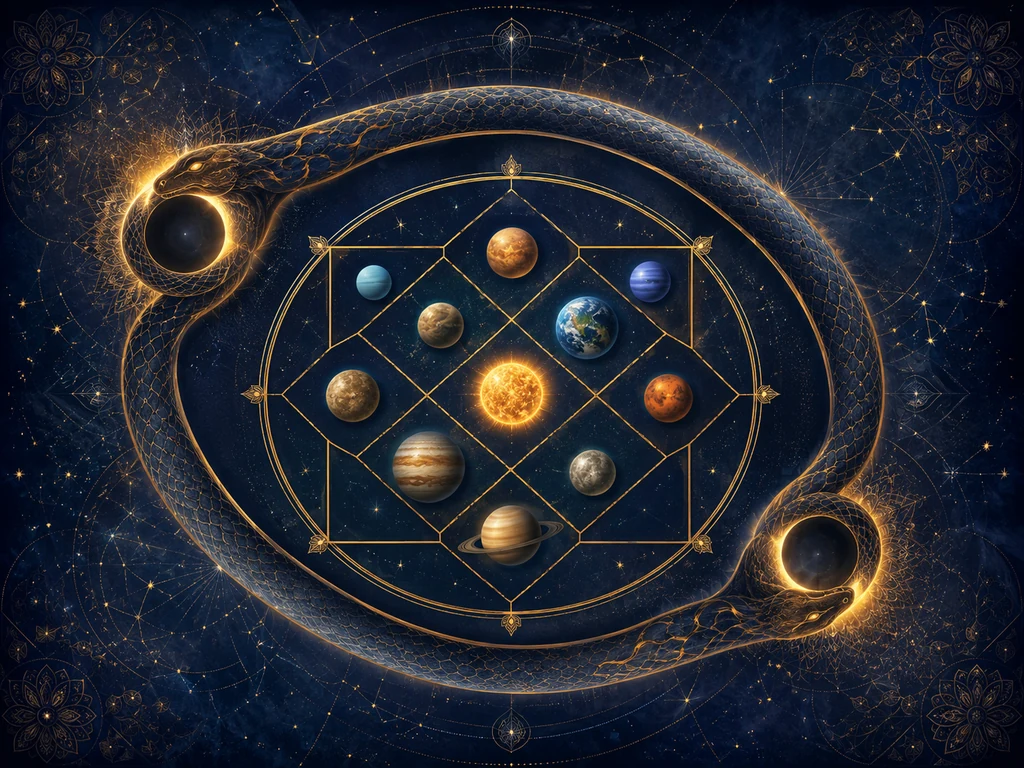
The condition is present only when the Sun, Moon, Mars, Mercury, Jupiter, Venus and Saturn all occupy the same half of the zodiac enclosed by the lunar nodes. That geometric enclosure can concentrate life around one karmic axis, but it does not cancel strong planets, benefic yogas, free will or ordinary chart judgment.
What does Kaal Sarp Dosha actually mean?
Kāla Sarpa literally evokes the “serpent of time,” with Rahu as the head and Ketu as the tail. In practical chart language, Kaal Sarp Dosha means that all seven classical planets are placed between Rahu and Ketu on one continuous side of the zodiac. Because the nodes are always opposite, they divide the chart into two semicircles; the claimed condition exists only when every classical planet falls inside one of them.
The Ascendant does not create or cancel the pattern because it is a sensitive point, not a planet. Uranus, Neptune and Pluto are also not used to establish this classical-style configuration. The test concerns the seven visible planets alone. Degrees matter: a planet sharing a sign with Rahu or Ketu may still fall outside the nodal boundary by degree, so checking signs without checking longitude can produce a false diagnosis.
The word “dosha” is often translated as defect, but that translation invites unnecessary fear. Here it is better understood as a potentially imbalanced configuration requiring context. A chart can show nodal concentration without showing ruin. It can describe pressure, unusual ambition, recurring extremes, a sense of being pulled between two life domains, or periods when worldly hunger and detachment alternate sharply.
Is Kaal Sarp Dosha really found in classical Vedic astrology?
A careful jyotishi should be candid: the exact modern formula called Kaal Sarp Dosha is not treated in the foundational texts as a universal chart-destroying verdict. The classical authorities do, however, give extensive rules for Rahu and Ketu, planetary strength, house results, yogas and dasha timing. Those rules provide the sound method for judging any nodal enclosure.
The Brihat Parashara Hora Shastra chapters on house lords and the nodes state the general Parashari principle that Rahu and Ketu tend to deliver the effects of the house they occupy, the planets they join and the relevant lords. That immediately tells us why a blanket reading fails: Rahu in the tenth with a strong tenth lord is not the same as Rahu in the eighth with a damaged dispositor.
Mantreswara’s Phaladeepika in English translation likewise judges planets through house placement, dignity, conjunction, aspect and planetary periods rather than by an isolated modern label. Saravali follows the same broader discipline of weighing strength and context. Jaimini techniques may add another layer through chara karakas, rashi aspects and sign-based periods, but Kaal Sarp should not be imported into Jaimini as though it were one of its primary named yogas.
“Kaal Sarp is a concentration pattern, not a cancellation stamp on the rest of the horoscope.”
How do you verify Kaal Sarp Dosha in a birth chart?
Begin with a correctly calculated sidereal chart and reliable birth time. Locate Rahu and Ketu by exact degree. Then move through the zodiac from one node to the other and note whether the Sun, Moon, Mars, Mercury, Jupiter, Venus and Saturn are all contained within that arc. Repeat the check through the opposite arc. One side will contain the planets if the full configuration exists; if even one classical planet lies beyond the nodal boundary, the strict condition is broken.
This is where many online reports go wrong. Suppose Rahu is at 12° Aquarius and Ketu at 12° Leo. A Moon at 18° Aquarius lies inside the Aquarius-to-Leo arc, but a Moon at 5° Aquarius lies on the other side of Rahu and breaks the enclosure. Both Moons are “in Aquarius,” yet only one satisfies that boundary test.
Some contemporary practitioners use terms such as partial Kaal Sarp when one planet has escaped or when a planet sits very close to a node. That may describe a chart still dominated by the nodal axis, but it should not be presented as the full condition. Clear language matters. A partial resemblance is not the same geometric pattern.
A dependable kundli analysis should also check whether the chart uses mean nodes or true nodes, because near a boundary the small difference can change the result. The interpretive framework should remain consistent from calculation through prediction.
Why can the pattern feel intense?
The nodes symbolise opposing processes. Rahu magnifies appetite, novelty, projection and the urge to cross limits. Ketu separates, internalises, simplifies and exposes the insufficiency of what has already been mastered. When every planet is enclosed between them, all planetary functions are recruited into that one polarity.
This does not mean every area of life is equally harmed. It means the chart’s energy is unusually concentrated. If the nodal axis falls across the first and seventh houses, identity and partnership become the theatre of development. Across the fourth and tenth, private security and public achievement compete. Across the second and eighth, inherited values, money, dependency and transformation become central.
The empty half of the horoscope is not literally inactive. Houses without planets still operate through their lords, aspects, dashas and transits. The enclosure simply gives the occupied half more visible weight. In consultation, people with a strong nodal concentration often describe life as moving in phases of total involvement followed by abrupt disengagement. The exact expression depends on the nodes’ dispositors and the planets nearest them.
How should a jyotishi read it without exaggeration?
First judge the Ascendant, its lord and the Moon. If the lagna lord is strong, well placed and supported, the person retains coherence even under nodal pressure. If the Moon is bright, dignified and protected by benefic influence, emotional regulation may be far better than the label suggests. If both are weak and closely afflicted by the nodes, the pattern deserves more attention.
Next judge Rahu and Ketu through their signs, houses, dispositors and associations. A node cannot be understood apart from the planet ruling its sign. If Rahu occupies Aquarius, Saturn’s condition is central. If Ketu occupies Leo, the Sun’s strength becomes central. A strong dispositor channels the node; a weak or afflicted dispositor leaves its appetite or detachment less organised.
Then examine planets near the nodal degrees. A Moon tightly joined Rahu may amplify emotional reactivity, public sensitivity or compulsive thought. Mercury near Rahu may produce an unconventional, highly associative mind but also informational overload. Venus near Ketu may create refinement and nonconformity in relationships while also bringing phases of distance. These are possibilities, not automatic outcomes.
After that, weigh ordinary yogas and dignities. Exaltation, own-sign placement, directional strength, varga support and benefic aspects do not disappear. Nor do difficult combinations. The correct judgment is additive: the nodal enclosure modifies the chart; it does not replace it. For deeper foundations, the separate guide to the Rahu–Ketu axis explains the nodes without repeating the full Kaal Sarp discussion.
A worked example: Rahu in Aquarius and Ketu in Leo
Consider a Taurus Ascendant at 3°. Place Rahu at 12° Aquarius in the tenth house and Ketu at 12° Leo in the fourth. Let the Moon be at 18° Aquarius, Saturn at 4° Pisces, Mars at 22° Aries, Venus at 28° Taurus, the Sun at 10° Gemini, Mercury at 6° Gemini and Jupiter at 9° Cancer.
Every classical planet lies on the continuous arc from 12° Aquarius through Pisces, Aries, Taurus, Gemini and Cancer to 12° Leo. The strict enclosure is therefore present. The Ascendant at 3° Taurus does not break it. If the Moon were instead at 5° Aquarius, it would fall behind Rahu’s degree and the full condition would no longer exist.
Now interpret, rather than panic. Rahu occupies the tenth and Ketu the fourth, so career, recognition, authority and public identity pull against inner rootedness, home and emotional privacy. The Moon six degrees from Rahu can make public response personally absorbing; the native may read professional approval as emotional security. Yet Venus, the Ascendant lord, is in its own sign Taurus, giving bodily steadiness, aesthetic intelligence and an ability to rebuild equilibrium. Jupiter is exalted in Cancer, strengthening counsel, learning and the capacity to find meaning.
Saturn, as ruler of Rahu’s sign, is in Pisces in the eleventh. Its condition suggests that career ambition must mature through networks, patient gains and service to a wider collective. The Sun, ruling Ketu’s sign, sits in Gemini with Mercury, linking the private side of the axis to skill, writing, commerce or analysis. This is not a chart of inevitable failure. It is a chart in which success may become consuming until the person deliberately develops an inner life equal to the public one.
A further check would examine the Navamsha, the strength of Venus and Saturn there, the Moon’s nakshatra, current dashas and relevant transits. A practitioner should not issue a prediction from the enclosure alone. A full personal horoscope report is useful only when it shows this chain of reasoning rather than printing a red warning beside the phrase “Kaal Sarp.”
When does Kaal Sarp Dosha give noticeable results?
A natal configuration is most audible when time activates it. Rahu mahadasha, Ketu mahadasha, their antardashas, or periods of planets conjoined with the nodes can bring the axis forward. Periods of the nodal dispositors are also important because those planets carry the nodes’ agenda into concrete houses and topics.
The exact sequence must come from the Moon’s nakshatra and birth balance, not from age-based guessing. The site’s guide to Vimshottari dasha timing covers that calculation separately. In practice, a difficult Rahu period may correspond to accelerated ambition, foreign or unconventional environments, overstimulation, identity experimentation or fixation. A Ketu period may coincide with pruning, withdrawal, spiritual inquiry, disillusionment or release. Neither is uniformly good or bad.
Transits matter most when Saturn, Jupiter, Mars or the nodes contact the natal nodal axis, its dispositors, the Moon or the Ascendant lord. In 2026, the true nodes shift to Rahu in Capricorn and Ketu in Cancer on 26 November. That date is relevant mainly for people whose natal nodes, luminaries, Ascendant or key dispositors are near the activated degrees and signs. The transit does not “create” natal Kaal Sarp in someone whose birth chart lacks it; at most, the moving planets can temporarily occupy one half of the zodiac, which is a different and much less personal phenomenon.
Does Kaal Sarp Dosha delay marriage or damage career?
It can correlate with delay or intensity in a specific area only when the nodal axis, house lords and timing all point there. For marriage, examine the seventh house, seventh lord, Venus, Jupiter where relevant, the Navamsha and running dashas. A Kaal Sarp label cannot override a strong seventh lord or supportive relationship yogas. Conversely, genuine affliction to the seventh house deserves attention even when no enclosure exists. Compatibility should be assessed through a complete kundli matching process, not by rejecting a person because one report printed this dosha.
Career judgment requires the tenth house, tenth lord, Sun, Saturn, relevant yogas and dashas. Rahu connected to the tenth can intensify ambition, technology, mass influence, foreign systems or unconventional status. It can also create image anxiety or sudden changes when poorly supported. The same placement may produce distinction in one chart and instability in another because the dispositor, dignity and periods differ.
What should you do if your chart has Kaal Sarp Dosha?
Start with verification. Obtain exact planetary degrees and ask the astrologer to show which arc contains every planet. Then ask for the condition of the Ascendant lord, Moon, nodal dispositors and planets nearest Rahu and Ketu. A competent reading should identify the life axis involved, the periods when it becomes active and the strengths that compensate for it.
Practical remedies should match the chart. Rahu generally benefits from disciplined reality-testing, clean commitments, reduced compulsive consumption and ethical conduct in unfamiliar or high-ambition environments. Ketu benefits from purposeful solitude, completion of neglected duties, contemplative practice and service without display. These are not magical punishments; they are behavioural ways of balancing excess and withdrawal.
Traditional upaya may include mantra, prayer, charity, temple observance or worship connected with one’s lineage and chosen deity. Such practices should be modest, sincere and sustainable. Gemstones are not universal remedies for the nodes and should never be prescribed from the Kaal Sarp label alone, because strengthening a planet can strengthen difficult house rulership or an already excessive tendency. For case-specific guidance, consult an experienced Vedic astrologer who explains the rationale rather than selling urgency.
When should you not worry?
Do not worry merely because a software report uses alarming language. Do not worry when one classical planet clearly lies outside the nodal arc, even if a website calls the chart “partial.” Do not worry when strong lagna, Moon, benefic yogas and well-supported dispositors provide resilience. Most importantly, do not treat ordinary setbacks as proof that a dosha is controlling your life.
Birth-time uncertainty is another caution. A small time error may change the Ascendant, house positions, divisional charts and dasha balance, even though the planets’ signs remain similar. Rectification may be necessary before making event-specific claims. The configuration itself may survive a small time change, but its house axis and practical meaning can alter.
Astrology is best used for guidance and reflection. It is not a substitute for medical, legal or financial advice, and no remedial ritual should delay professional help.
Frequently asked questions about Kaal Sarp Dosha
Can Kaal Sarp Dosha be cancelled?
There is no single universally classical “cancellation” rule because the modern configuration itself is not judged like one of the standard yogas with a fixed bhanga formula. In practice, strong dispositors, dignified planets, benefic aspects, a robust Ascendant and Moon, and favourable dashas can substantially reduce difficult expression. It is better to speak of modification and support than total cancellation.
Does a planet with Rahu or Ketu break the pattern?
Its exact degree decides. A planet can be in the same sign as a node yet fall either inside or outside the enclosed arc. Conjunction by sign is not enough for verification. Use longitude.
Is partial Kaal Sarp Dosha dangerous?
“Partial” is a modern descriptive term, not a reason for a severe verdict. One planet outside means the strict full enclosure is broken. The chart may still be node-dominant if several planets cluster near the axis, but that should be read as concentration, conjunction or dispositorship—not inflated into a fatal condition.
Are there twelve types of Kaal Sarp Dosha?
Modern manuals often name the pattern according to the houses occupied by Rahu and Ketu. Those names can be shorthand for the axis, but they do not replace actual house analysis. Rahu in the first and Ketu in the seventh must be read through identity, partnership, their lords and timing; the label attached to that axis adds little unless the underlying logic is explained.
Can Kaal Sarp Dosha bring success?
Yes. Concentrated charts can produce unusual focus, ambition, endurance and a willingness to enter fields others avoid. Success is more likely when the Ascendant lord, nodal dispositors, tenth house and relevant dashas are strong. The same concentration can become obsession if there is no inner counterweight. The mature expression is not escape from the axis, but conscious use of it.