Lagna, Moon or Sun: Which One Is Really Your Sign?
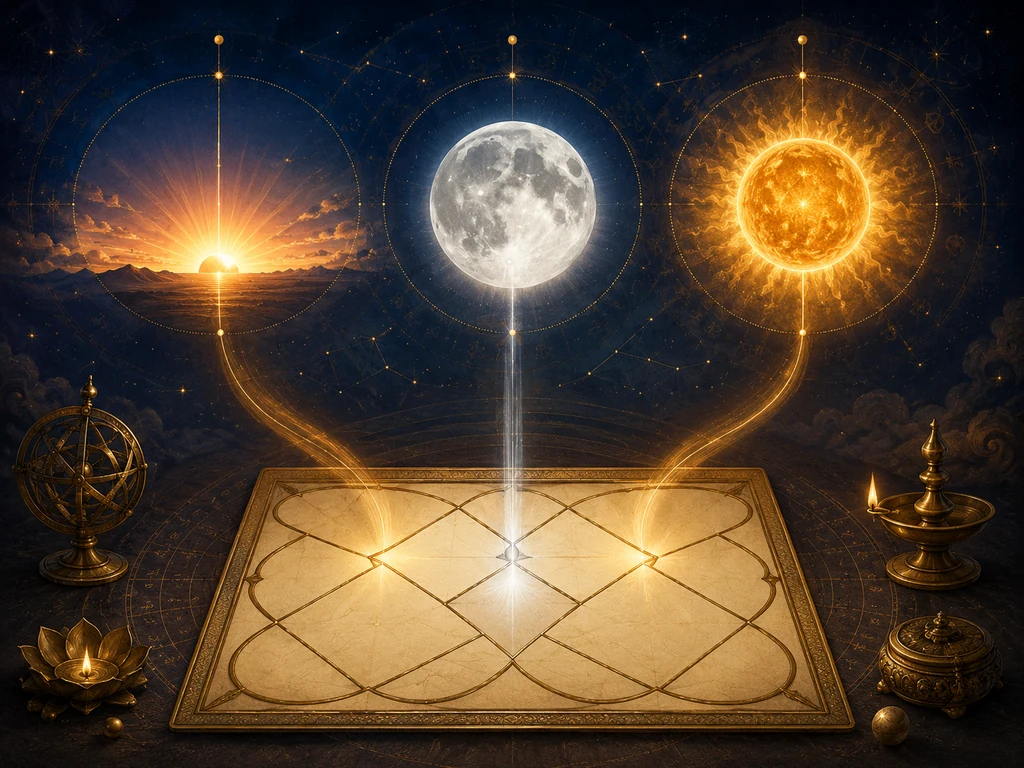
In Vedic astrology, Lagna describes lived life, the Moon reveals the mind, and the Sun shows vitality and purpose. Your full chart needs all three together.
In Vedic astrology, no single placement owns the title “your sign.” If one factor must lead, Lagna is the primary reference for the embodied life and the structure of the horoscope; the Moon sign describes the mind and lived experience; the Sun sign shows vitality, authority and the direction of selfhood. A serious reading uses all three, then checks their rulers, houses, strength and timing.
What does “your sign” mean in Vedic astrology?
The confusion begins because three different questions are compressed into one phrase. “What is my sign?” may mean the sign rising at birth, the sign occupied by the Moon, or the sign occupied by the Sun. These are not rival answers. They are three coordinates in the same birth chart.
In modern Western popular astrology, “your sign” usually means the Sun sign, identified broadly from the birth date. In Indian usage, rashi often means Chandra Rashi, the Moon sign. In classical Jyotish practice, however, Lagna, or the ascendant, usually supplies the main framework because it establishes the first house and therefore the placement of every other house.
Two people born on the same date can share a Sun sign yet have sharply different charts. Their Lagnas may differ because of birth time and place; their Moon may occupy a different degree or sign; and the planets may rule completely different houses.
Britannica’s overview of Sun, Moon and rising signs is useful for the general distinction, but Vedic astrology normally calculates these factors in a sidereal zodiac using an ayanamsha. That can produce different sign positions from a tropical Western chart, especially near sign boundaries.
“In Jyotish, the Lagna is the stage, the Moon is the experience of the play, and the Sun is the light that gives the actor direction.”
Why is Lagna usually the first thing a jyotishi reads?
Lagna is the degree of the zodiac rising on the eastern horizon at the moment and place of birth. It is not merely a personality badge. It opens the first house, fixes the twelve-house sequence and determines which planets become functional benefics, functional malefics, yogakarakas or lords of difficult houses for that chart.
The Brihat Parashara Hora Shastra treats the ascendant, its lord and the houses from it as foundational to judgement. A digitised edition of BPHS is available for readers who want the classical source directly. Phaladeepika and Saravali likewise give major weight to the ascendant, planetary lordship, dignity, aspects and house occupation rather than reducing a life to one sign.
Lagna describes the native’s physical entry into life: body, orientation, temperament, visible conduct and the circumstances through which karma becomes concrete. It also tells us where marriage, career, wealth, illness, children, home and other topics sit in the chart. Without the Lagna, there is no reliable house map.
Yet “my Lagna is Capricorn” is not a complete interpretation. A jyotishi must inspect Saturn, because Saturn rules Capricorn. Is Saturn dignified, combust, retrograde, joined benefics, pressured by malefics, placed in a supportive house, or weakened in divisional charts? Are planets occupying or aspecting the first house? The sign must be read through its ruler.
Birth time matters because the ascendant changes quickly, often entering a new sign within roughly two hours, although the duration varies by latitude and sign. Even a few minutes can matter near a sign boundary or when divisional charts are used. Uncertain birth time should therefore be treated as a real interpretive limitation.
What does the Moon sign reveal that Lagna does not?
The Moon signifies manas: the receiving, remembering and reacting mind. It shows emotional regulation, habit, familiarity, attachment, sleep, nourishment and the way experience is internally registered. Lagna may describe what happens and how the person meets the world; the Moon describes how that life feels from inside.
The Moon is also central to timing. Its nakshatra at birth establishes the starting point of the widely used Vimshottari dasha sequence. The Moon’s exact degree therefore matters more than a generic statement such as “Aquarius Moon.” The sign gives one layer, but the nakshatra, its ruler, the Moon’s phase, house, dignity, conjunctions and aspects refine the result. Our guide to the Moon’s nakshatra and life rhythm explains that layer in depth.
Classical texts often judge important matters from both Lagna and the Moon. When the same theme is strong from both reference points, the promise is reinforced. When one is strong and the other strained, external achievement and internal ease may not arrive together. A person can build a respected career from a powerful tenth house from Lagna while feeling emotionally unfulfilled if the lunar factors are under pressure.
The Moon sign is especially important in transit traditions. Public forecasts frequently count Jupiter, Saturn, Rahu and Ketu from the natal Moon because it is a sensitive measure of subjective experience. Sade Sati itself is defined through Saturn’s movement through the twelfth, first and second signs from the natal Moon. Even then, a proper reading of the three phases of Sade Sati must return to the natal chart, Saturn’s lordship and the houses activated from Lagna.
What does the Sun sign mean in a Vedic chart?
The Sun signifies atma in the broad astrological sense of central vitality, coherence and the power to stand in one’s authority. It is associated with illumination, leadership, father figures, government, status, integrity and confidence. The Sun sign matters, but not in isolation.
A Vedic Sun sign is not a personality profile copied from a date range. The Sun must be read by house, dignity, lordship and association. An exalted Sun may confer courage and visibility, but if it rules or occupies a difficult house, its strength can produce intense responsibilities rather than uncomplicated ease. A debilitated Sun does not condemn a person to weakness; cancellation, aspects, house placement, divisional strength and dasha activation can alter the outcome.
The Sun moves slowly enough that many people born across a month share the same sign. Its individuality emerges through the house it occupies, the houses it rules, the planets influencing it and the architecture created by Lagna.
In practice, the Sun asks: Where must this person develop self-respect? Through what field do they seek recognition? How do they relate to authority? Where can pride become clarity, and where can it become rigidity? These are essential questions, but they are not the whole horoscope.
How should Lagna, Moon and Sun be read together?
Begin with the Lagna as the chart’s structural centre. Read the sign, exact degree, first-house occupants, Lagna lord, dignity, house, aspects and condition in the navamsha. This shows what kind of vehicle the person has been given and how readily it can carry the chart’s promises.
Then read the Moon as the inner witness and timing seed. Examine its sign, house, nakshatra, phase, strength, associations and dispositor. A waxing Moon with support behaves differently from a dark Moon under pressure, even in the same sign. The Moon’s lord and nakshatra lord connect the emotional field to other houses and planets.
Next read the Sun as the organising flame. Judge its sign, house, lordship, dignity, aspects and conjunctions. Note whether it supports the Lagna lord, conflicts with it, or occupies a house that makes authority a central lesson. Combustion must be handled carefully: planets close to the Sun may lose some independent expression, but the result depends on the planet, degree and wider chart.
Finally, compare the three rulers. If the Lagna lord, Moon lord and Sun lord are mutually supportive, the outer path, inner needs and sense of purpose can cooperate. If they are in difficult relationships, life may involve integration work. That does not mean the person is “three different personalities.” It means different layers mature at different speeds.
Jaimini astrology adds further lenses such as Chara Karakas and Arudha Lagna. These can reveal soul significations, public image and the manifest appearance of life, but they deepen rather than replace the Lagna-Moon-Sun synthesis.
A worked example: Capricorn Lagna, Aquarius Moon, Leo Sun
Consider a mini-chart with Capricorn Lagna at 12°, Moon at 18° Aquarius and Sun at 2° Leo. Let Saturn, the Lagna lord, be placed in Scorpio in the eleventh house. This is not a complete horoscope, but it shows why asking for one “real sign” gives a poor answer.
Capricorn rising makes Saturn the governor of the chart’s physical direction. The person may approach life through caution, duty, sequencing and long-term construction. Because Saturn sits in the eleventh house, networks, institutions, gains, elder allies and sustained ambitions become important arenas. Saturn in Scorpio adds intensity, privacy and strategic endurance. Aspects, conjunctions and divisional strength would still decide how smoothly this operates.
The Moon at 18° Aquarius falls in the second house from Capricorn Lagna. The inner life is tied to speech, family culture, food, stored resources and values. Aquarius gives the Moon a more observant, conceptual and socially aware style, yet it can create emotional distance when feelings are processed through ideas before being spoken.
At 18° Aquarius, the Moon is in Shatabhisha nakshatra, fourth pada. Because Shatabhisha is ruled by Rahu, the Vimshottari sequence begins from Rahu. At exactly 18°, about two degrees of the nakshatra remain, so roughly fifteen percent of Rahu’s eighteen-year period remains at birth: about two years and eight months. This shows why the Moon’s degree, not just its sign, is indispensable. The broader mechanics are covered in our guide to Vimshottari dasha timing.
The Sun at 2° Leo occupies its own sign in the eighth house. The Sun is dignified, but the eighth house directs solar power toward research, hidden systems, crisis management, inheritance, secrecy, vulnerability and transformation. The native may possess strong will and pride, yet learn authority through situations that cannot be controlled by surface confidence alone. A strong planet in a difficult house often gives capacity to handle that house, not immunity from its subjects.
Which sign is this person? For the outer life and house structure, Capricorn Lagna leads. For emotional patterning and dasha entry, Aquarius Moon is indispensable. For purpose, pride and authority, Leo Sun speaks clearly. The synthesis is more revealing: a restrained, strategic outer style; a mentally independent emotional nature; and a strong need to master complex or hidden domains.
When does each one become more important?
Lagna remains the basic reference throughout life because every planetary period and transit activates houses measured from it. During Saturn dasha in the example, Saturn’s role as Lagna lord and second-house lord would become central, linking identity, health, speech, wealth and long-term gains. The event field comes from lordship and house placement, not from the label “Capricorn” alone.
The Moon becomes prominent during its own dasha or the dasha of its sign lord and nakshatra lord, during major transits over or from the Moon, and when emotional security, family or mental equilibrium are under review. Because Vimshottari begins from the Moon’s nakshatra, lunar condition colours the native’s relationship with timing.
The Sun becomes more visible in Sun dasha, Sun antardasha, important solar transits, career transitions, dealings with authority, questions involving father figures, and periods demanding stronger self-definition. Monthly Sun-sign forecasts cannot replace natal analysis. They are best treated as one narrow layer within a fuller Vedic horoscope.
A transit should ideally be judged from both Lagna and Moon. From Lagna, it shows the concrete house of action. From the Moon, it shows the experienced pressure, opportunity or mental climate. When both point to the same topic and the dasha supports it, timing becomes more persuasive.
What should you actually do with these three signs?
Use Lagna for the overall design of the chart, house lordships, health, life direction and concrete events. Use the Moon for emotional response, habit, belonging, transit experience and dasha sequencing. Use the Sun for vitality, authority, visibility, self-respect, leadership and the need to live from a coherent centre.
Then stop treating signs as isolated adjectives. “Aries is bold,” “Cancer is emotional,” and “Aquarius is detached” are not readings. Ask where the sign falls, who rules it, whether that ruler can act, which planets influence it and whether the relevant dasha has arrived. A dormant promise and an activated promise are not the same thing.
If birth time is reliable, begin with Lagna. If the time is uncertain but the date is secure, the Moon and Sun may still be usable, although the Moon can change sign within a day and its house cannot be trusted without a valid Lagna. Near an ascendant boundary, rectification should be based on dated life events, not on choosing the sign whose description feels flattering.
Is your Moon sign the same as your rashi?
Usually, when an Indian astrologer casually asks for your rashi, they mean the sign occupied by the Moon. But in classical chart language, rashi simply means a zodiacal sign, and every planet occupies one.
This shortcut explains why families may know a child’s Moon sign and nakshatra while being less familiar with the ascendant. A person may say, “I am Aquarius,” while their Lagna is Capricorn and Sun is Leo. The statement is not wrong; it is incomplete.
Which sign should you read in a daily horoscope?
If a Vedic forecast is explicitly written by Moon sign, read your Moon sign. If it is written by ascendant, read your Lagna. When the method is not stated, the forecast is too generic to carry much weight.
For broad transit reading, compare both. The Lagna version often describes where events may materialise; the Moon version describes how the period is experienced. The Sun sign can be read as an additional layer, especially for visibility and authority, but it should not overrule the other two.
What if Lagna, Moon and Sun seem to contradict each other?
Apparent contradiction is often the most truthful part of the chart. A fiery Sun may want decisive recognition, a watery Moon may need safety and retreat, while an earthy Lagna moves cautiously. The person is not inconsistent; they are negotiating different needs.
Maturity appears when the chart factors find a working hierarchy. Lagna handles the practical path, the Moon receives and regulates experience, and the Sun supplies direction. Problems arise when one factor is forced to perform the work of all three, such as demanding that career success cure emotional insecurity.
Which one is really your sign?
If you need one concise Vedic answer, your Lagna is the primary sign for reading the whole life, because it creates the houses and functional lordships. Your Moon sign is primary for the mind, nakshatra-based timing and many transit judgements. Your Sun sign is primary for vitality, authority and conscious purpose.
A good jyotishi does not choose one and discard the others. The chart becomes accurate when these three are synthesised with their rulers, houses, strengths, divisional support, dashas and transits. Astrology is best used for guidance and reflection; it is not a substitute for medical, legal or financial advice.