Saturn Mahadasha: The Nineteen Years That Build to Last
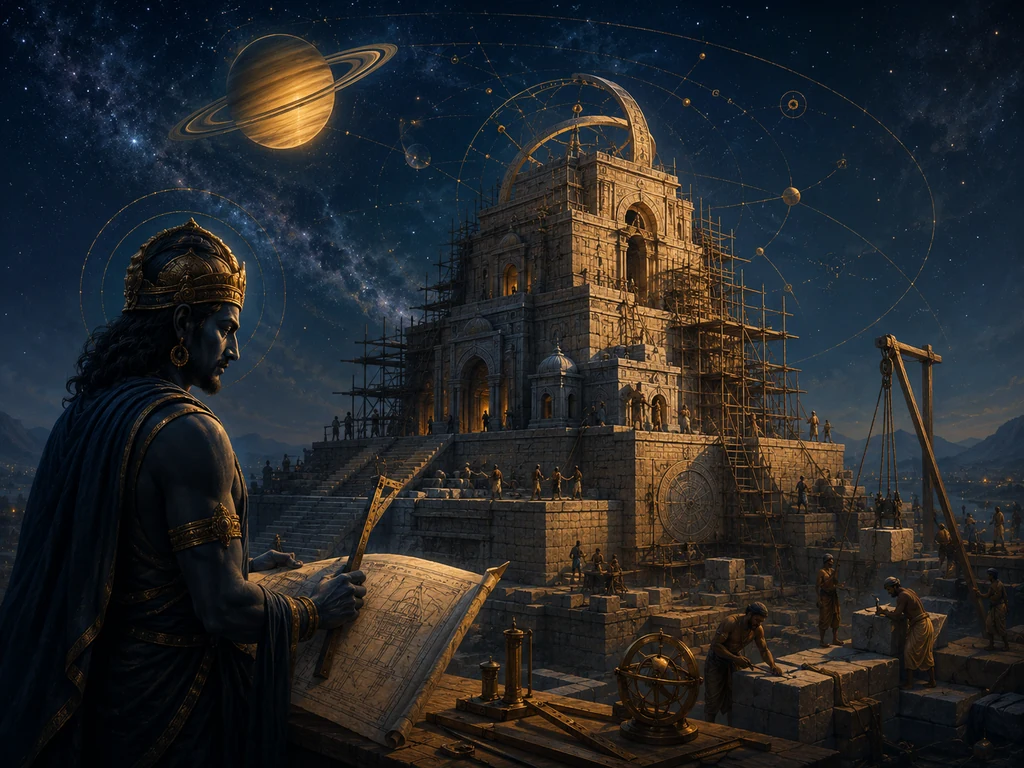
Saturn mahadasha is a nineteen-year period of responsibility, consolidation and earned results—not a punishment, but a test of what can endure over time.
Saturn mahadasha is not a nineteen-year punishment. It is a long planetary period in which the condition of Saturn in the birth chart brings responsibility, limits, work, maturity and durable results to the foreground. A strong, well-placed Saturn can consolidate status and mastery; a strained Saturn can expose neglected structures, but even then the period is read as a process to manage—not a verdict.
What does Saturn mahadasha actually mean?
In Vimshottari dasha, the 120-year planetary timing cycle most commonly used in Parashari astrology, Saturn receives nineteen years. The Sanskrit name Shani mahadasha means the major period governed by Saturn; after introducing the term, it is more useful to speak plainly of the Saturn period. For the broader mechanics of the system, see Vimshottari dasha explained rather than treating this article as a second introduction.
The Brihat Parashara Hora Shastra assigns the period length, but it does not support the modern shortcut that Saturn must produce one fixed catalogue of events. Dasha results arise through the planet’s house ownership, placement, dignity, strength, aspects, conjunctions and the houses it activates. The same natural planet can therefore behave very differently for two ascendants.
Saturn signifies time, labour, hierarchy, persistence, scarcity, accountability, age, maintenance and the parts of life that cannot be rushed. During its major period, these subjects acquire decision-making power. That may look like entering a demanding profession, caring for elders, assuming debt or property obligations, working inside a large institution, rebuilding health routines, or accepting that a relationship needs clearer terms. The outer form varies; the common denominator is consequence sustained over time.
“Saturn mahadasha does not ask whether a plan is exciting. It asks whether the plan can survive repetition, responsibility and time.”
Why does Saturn mahadasha last nineteen years?
Nineteen years is Saturn’s allotted span within Vimshottari; it is not calculated from Saturn’s orbital period and should not be confused with a Saturn return. The length matters because slow themes have time to mature. Saturn’s characteristic results usually emerge through accumulation: qualifications earned, systems built, obligations carried and reputations formed through consistency.
That does not mean all nineteen years feel alike. The major period is divided into nine antardashas, or subperiods, beginning with Saturn and proceeding through the standard Vimshottari sequence. Each subperiod planet temporarily colours Saturn’s agenda. The major-period lord sets the terrain; the subperiod lord indicates which room in that terrain is currently open.
A person can therefore experience career consolidation in Saturn–Mercury, relationship decisions in Saturn–Venus and severe simplification in Saturn–Ketu without contradiction. Our separate guide to antardasha inside antardasha explains that layering in detail.
How do you read Saturn mahadasha in a birth chart?
Begin with the ascendant, not with Saturn’s reputation. Saturn rules two houses in every chart, and those houses show which departments of life it carries into its period. For Taurus and Libra ascendants, Saturn owns both an angle and a trine and can function as a yogakaraka, a planet capable of joining purpose with concrete action. For Cancer or Leo ascendants, its ownership is more complicated and demands a more guarded reading. “Saturn is malefic” is therefore an incomplete sentence.
Next judge the sign and house. Saturn in Capricorn, Aquarius or Libra usually has more capacity to act according to its disciplined nature, though house ownership and affliction still matter. Saturn in Aries is debilitated, but debility alone does not finish the judgment; cancellation, aspects, divisional strength and the actual houses ruled can materially alter the outcome. Saravali repeatedly differentiates planetary effects by sign, house and association, which is precisely why one-line dasha predictions are unreliable.
Then examine conjunctions and aspects. A benefic influence may supply judgment, support or constructive opportunity. A harsh association may make Saturn’s work more pressured, conflict-ridden or physically draining. Saturn’s special third, seventh and tenth aspects identify areas that receive sustained pressure or organisation. These aspects do not automatically “damage” a house; they often make that house demand patience, duty and realism.
The natal chart is primary, but the navamsha helps show Saturn’s deeper dignity, while a relevant divisional chart may clarify the field. The tenth division (Dashamsha, D-10) is useful for profession, the seventh (Saptamsha, D-7) for children, and the ninth (Navamsha, D-9) for marriage and dharma, but a divisional chart should refine—not overturn—the main chart. A properly cast kundli is essential because a wrong birth time can change house placement and divisional charts.
Finally, judge the Moon and the starting dasha balance. The Moon’s nakshatra determines where the Vimshottari sequence begins and how much of the first period remains at birth. Without that calculation, an astrologer may describe Saturn well yet time it badly.
Which Saturn placements tend to carry more support?
A Saturn period is generally easier to use when Saturn owns constructive houses, occupies its own or exaltation sign, sits in an angle or trine without severe affliction, receives support from functional benefics, and remains competent in the navamsha. Such a Saturn can produce authority, technical mastery, property, institutional responsibility, stable income or influence over large systems. The result is seldom effortless, but effort has somewhere to go.
A difficult Saturn period is more likely when Saturn is weak, severely afflicted, poorly placed for the ascendant, or tied to difficult houses without compensating strength. Then the period may bring heavier workloads, conflict, isolation, chronic delay, expenditure, litigation, health maintenance or repeated restructuring. Even here, the chart must specify the field and the degree; “bad Saturn” is not a diagnosis.
The classical texts themselves are more mixed than popular Saturn folklore. Mantreswara’s Phaladeepika gives both gain-producing and difficult outcomes among Saturn’s subperiods. Read in a modern chart, the important lesson is not to repeat every medieval event literally. It is to preserve the method: the subperiod, planetary relationship and natal promise decide which part of Saturn becomes visible.
How do Saturn antardashas change the period?
Saturn–Saturn lasts about three years and often establishes the uncompromising baseline. Responsibilities become clearer, delays reveal their cause and the person learns what the next sixteen years will require. When Saturn is strong, this phase can formalise a career, property, long project or position of authority. When it is strained, the same phase may feel like compression: fewer options, more duties and a need to repair fundamentals before expanding.
Later subperiods do not cancel Saturn. Mercury can introduce education, contracts, trade, analysis or communication; Venus can bring relationships, comforts, vehicles, art or agreements; Mars can produce decisive work, conflict or technical action; Jupiter can widen responsibility through teaching, children, counsel or institutions. Whether those topics prosper depends on the subperiod planet’s rulership, dignity and relationship with Saturn in the actual chart.
This is also why predictions based only on the major period become vague. “Your Saturn mahadasha will improve after a few years” is not a method. A credible judgment should name the operative houses, the antardasha, the relevant transit and the natal combinations being activated. A detailed dasha report should show that chain rather than present generic yearly adjectives.
When do Saturn mahadasha results become visible?
The change of major period can be noticeable near the boundary, but it does not always arrive as a single event on the first day. Life may begin rearranging during the closing subperiod of the previous mahadasha, especially when Saturn connects strongly with that subperiod lord. The opening Saturn–Saturn phase then makes the new priorities harder to ignore.
Results become concrete when several clocks agree. The mahadasha must permit the topic, the antardasha must activate it, and transits should connect with the relevant natal planet or house. Jaimini techniques can be used as corroboration when the practitioner is trained in them, but a Jaimini sign period should not be mixed casually into a Parashari reading until every system says whatever the reader hopes to hear.
Saturn’s own transit is important, yet it is not identical with Saturn mahadasha. A person may run Saturn mahadasha without undergoing sade sati, and may undergo sade sati during another planet’s major period. A Saturn return is another separate cycle. Overlap increases emphasis, not certainty.
Worked example: Moon at 18° Aquarius and Saturn in the tenth
Consider a Taurus ascendant with Saturn at 12° Aquarius in the tenth house and the Moon at 18° Aquarius. Saturn owns the ninth and tenth houses, making it the chart’s yogakaraka, and it occupies its own sign in an angle. This gives Saturn strong capacity to build profession, rank, systems and public responsibility. The Moon’s conjunction adds visibility and emotional investment, but it can also make professional pressure feel personal.
The Moon at 18° Aquarius falls in Shatabhisha, Rahu’s nakshatra, which runs from 6°40′ to 20° Aquarius. At 18°, two degrees of the nakshatra remain, or about fifteen percent. Roughly fifteen percent of Rahu’s eighteen-year period therefore remains at birth: about two years and eight months, subject to the calendar convention used by the software. Jupiter’s sixteen years follow, so Saturn mahadasha begins near age eighteen years and eight months.
In this example, the Saturn period is not primarily a story of obstruction. It is a story of early professional seriousness. The native may enter a structured field, accept responsibility sooner than peers, work with technology, administration, regulation, research or large organisations, and gradually become known for reliability. Because the Moon is joined Saturn, public success may coexist with periods of low morale, self-criticism or difficulty switching off from work.
Saturn’s third aspect reaches Aries, the twelfth house; its seventh reaches Leo, the fourth; and its tenth reaches Scorpio, the seventh. Consequently, career growth cannot be judged alone. Expenditure, sleep, foreign links or retreat may require discipline; home and property may carry obligations; partnership may demand patience and formal commitment. None of these is automatically denied. They become areas where casual arrangements are less likely to survive.
During Saturn–Saturn, the native may enter training, a first serious job or a demanding institution. During Saturn–Mercury, because Mercury rules the second and fifth houses for Taurus, qualifications, analytical work, income and skill-based advancement may become more prominent if Mercury is sound. A later Saturn–Venus period can bring identity, relationship and material questions to the front because Venus rules the ascendant and the sixth, but the exact result still depends on Venus’s placement. This is how a practitioner moves from “Saturn equals delay” to a testable reading.
What does 2026 add to a running Saturn period?
Saturn remains in sidereal Pisces throughout 2026. For anyone in Saturn mahadasha, that transit activates the Pisces house from the ascendant and Moon, but it does not produce the same outcome for all charts. The natal Saturn and current antardasha remain the foundation.
Jupiter enters Cancer, its exaltation sign, on 2 June 2026 and remains there until entering Leo on 31 October 2026. From Cancer, Jupiter casts its ninth aspect to Saturn in Pisces. This creates a useful period for combining expansion with structure: education with certification, growth with compliance, faith with practical service, or opportunity with a realistic timetable. Jupiter is combust in Cancer approximately 14 July to 12 August, so practitioners generally avoid treating that interval as ideal for major Jupiter-led muhurtas, although ordinary life and dasha results continue.
Rahu enters Capricorn and Ketu enters Cancer on 26 November 2026 by the true-node reckoning. That shift can redirect ambition, detachment and restlessness toward the houses occupied by Capricorn and Cancer. It should be read as a late-year trigger, not as a replacement for the natal chart. Transits open windows; the dasha decides which windows belong to the building.
What should you do during Saturn mahadasha?
The most effective Saturn remedies are often behavioural before they are ceremonial. Keep records. Honour deadlines. Maintain the body before a minor issue becomes a long one. Reduce avoidable debt, read contracts, repair neglected property, learn the unglamorous part of your profession and build routines that still function on difficult days. Saturn responds symbolically to consistency because consistency is its language.
Traditional practice may include prayer to Shani, recitation of an appropriate mantra, charity, and service to elderly, poor, disabled or labouring people. Such practices should be undertaken respectfully and within one’s tradition, not as transactions to “cancel” a planet. Gemstones deserve particular caution. Blue sapphire is not a universal Saturn remedy and should not be prescribed from the mahadasha name alone; the planet’s functional role and the whole chart must first be judged by a competent Jyotish practitioner.
The deeper remedy is right relationship with time. Promise less and complete more. Replace panic with scheduling. Let skill compound. Leave space for rest, because discipline without recovery becomes brittleness rather than strength.
What are the biggest myths and cautions?
The first myth is that Saturn mahadasha ruins everyone. It does not. Some of the most consequential promotions, marriages, properties, businesses and bodies of work arise in Saturn periods because Saturn can stabilise what other planets initiate. The price is usually accountability.
The second myth is that delay means denial. Saturn can deny when the chart clearly supports denial, but it often postpones until conditions are adequate. A delayed marriage may be a marriage entered with greater clarity; a slow career may become a durable specialisation. The astrologer must distinguish “not yet,” “not in this form” and “not promised” rather than using one word for all three.
The third myth is that suffering proves spiritual progress. Exhaustion, illness, abusive work or a harmful relationship should not be romanticised as Saturn’s lesson. Astrology is for guidance and reflection, not a substitute for medical, legal or financial advice. Practical help should be sought when the situation requires it.
Is Saturn mahadasha always bad?
No. Its quality depends on Saturn’s functional role, dignity, house placement, associations, divisional strength, antardasha and transits. A strong yogakaraka Saturn may give status and lasting achievement; a weak or afflicted Saturn may demand repair and restraint. Most real charts produce a mixture.
Does Saturn mahadasha always delay marriage or career?
No. Saturn can formalise marriage and career because commitment, contracts and institutions belong naturally to its domain. Delay is more likely when Saturn connects adversely with the relevant house, lord and significator, and when the operating subperiod repeats the obstruction. Without that repetition, a blanket prediction is unsound.
Are Saturn remedies necessary?
Remedies are optional supports, not substitutes for judgment or action. Ethical conduct, disciplined service, maintenance and realistic planning are broadly appropriate. Mantra, worship, donation or fasting should fit the person’s health, beliefs and chart. A remedy that creates fear, expense or dependency has missed Saturn’s lesson.
How do I know whether the period will build something lasting?
Look for repetition. If Saturn links the ninth and tenth houses, profession and purpose may consolidate. If it connects the second and eleventh, income and assets may become central. If it strongly activates the fourth, home, property and inner stability require long work. When the same topic appears through house ownership, placement, antardasha and transit, it is likely to become one of the period’s durable outcomes.
Saturn mahadasha is long enough to expose fantasy and long enough to reward craft. It does not promise that every structure will survive. It gives nineteen years in which the structures that deserve to survive can be tested, repaired and made real.