Gemstones Are Not Jewellery: When a Ratna Can Backfire
A Vedic astrology gemstone strengthens a planet, not just luck. Learn when a ratna helps, when it backfires, and how a chart should be judged carefully first.
A gemstone in Vedic astrology is an amplifier, not a universal good-luck charm. It is worn to strengthen the planet it represents; if that planet is helpful in the birth chart, the reinforcement may be constructive, but if it rules or activates difficult houses, the same reinforcement can intensify the problem. That is why a ratna can support one person and backfire for another, even when both wear an equally beautiful stone.
What does a ratna actually mean in Jyotish?
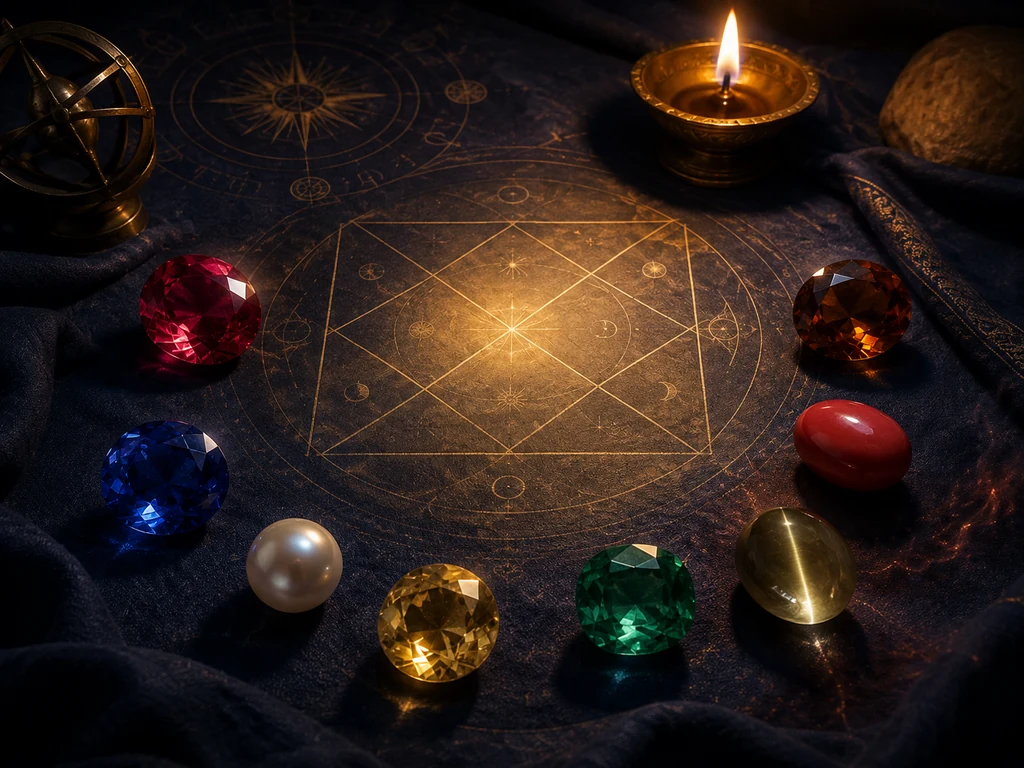
Ratna means a precious gem, but in Jyotish it is more useful to think of it as a concentrated planetary symbol. The classical tradition assigns colours, metals, substances, directions and gems to the grahas. Phaladeepika, in its chapter on planetary attributes, explicitly associates the Moon with pearl, Mars with coral, Mercury with emerald, Jupiter with yellow topaz, Venus with diamond and Saturn with sapphire, while also naming stones for the lunar nodes. The Phaladeepika translation of these correspondences is valuable because it shows that the planet–gem relationship is not a recent commercial invention.
Yet correspondence is not the same as prescription. A text may say which gem belongs to Jupiter without saying that every person with a troubled Jupiter should wear yellow sapphire. The prescription begins only after the astrologer judges the planet’s lordship, dignity, placement, aspects, conjunctions, divisional strength and operating period.
This distinction is where much popular gemstone astrology goes wrong. “Your Moon is weak, wear a pearl” sounds neat, but it skips the central question: what does the Moon govern in this particular chart, and what will happen if its agenda becomes stronger?
How does a Vedic astrology gemstone work?
Within traditional practice, a gemstone works through sambandha, or correspondence: the stone is linked with a planet by colour, luminosity, substance and inherited ritual association. Wearing it against the body, usually in a prescribed metal, is treated as a continuous strengthening remedy. The stone does not replace the graha, nor does it erase the natal chart. It is intended to make that planet’s significations more available, noticeable or forceful.
Some modern explanations speak of rays, frequencies or colour vibrations. These may be meaningful as metaphors, but they should not be presented as established physics. A gem laboratory can identify the material, distinguish many natural stones from synthetic ones and report detectable treatments; it cannot certify that a stone is astrologically suitable. The GIA explanation of coloured-stone reports is useful for the material question of what the buyer is actually purchasing.
From the practitioner’s chair, the working rule is simpler: a gemstone tends to strengthen, whereas many other remedies aim to pacify, honour or discipline a planet. Mantra, charity, conduct, fasting, service and devotional practice may be chosen when amplification is not desirable. A difficult Saturn, for example, may call for patience, duty and service rather than an automatic blue sapphire.
“A gemstone does not ask whether a planet is naturally benefic; it reinforces the planet you actually have in the chart.”
How do you decide which gemstone suits a birth chart?
The first step is not the gem catalogue. It is an accurately cast kundli. A small birth-time error can change the ascendant, house boundaries and sometimes the functional role of the very planet being considered. Before discussing colour, carat or finger, the astrologer should establish what the planet owns and what it is capable of delivering.
In Parashari astrology, lordship is decisive. Jupiter is a natural benefic, but it does not become functionally benefic for every ascendant. Mars is a natural malefic, yet for Cancer and Leo ascendants it can become a powerful yoga-producing lord. Brihat Parashara Hora Shastra repeatedly evaluates results through house lordship, placement, association, aspect and timing; Saravali likewise treats planetary outcomes as conditioned by sign, house and relationship rather than by the planet’s natural label alone. The needed distinction is explained more fully in functional benefics and malefics.
Next comes strength. A weak planet is not automatically a planet to strengthen. Weakness may mean debilitation, combustion, infancy, old age, poor divisional dignity, low directional strength or defeat in planetary war. Each form has a different meaning. A planet can be weak in one metric yet protected by a strong dispositor, supported in the navamsa or improved through cancellation. A proper assessment therefore includes planetary strength and shadbala, but does not reduce judgement to one score.
The astrologer then asks whether the planet is connected to the life area the client wants to improve. A gemstone for career should have a credible relationship with the tenth house, its lord, the ascendant, the relevant significator and the active dasha. A gem chosen only because it is fashionable, affordable or associated with wealth has no chart-specific logic.
Finally, the potential cost of strengthening the planet must be examined. A planet may promise professional rise and domestic strain at the same time. It may own a trine and a maraka house. It may form a yoga but sit in a house of conflict. Good prescription is rarely “this planet is good” or “this planet is bad”; it is a judgement about which results should be reinforced now, and which risks can reasonably be accepted.
When can a gemstone backfire?
A gemstone most often backfires when the astrologer mistakes natural beneficence for functional beneficence. Yellow sapphire is then given for every weak Jupiter, pearl for every anxious Moon, emerald for every retrograde Mercury and blue sapphire for every difficult Saturn. The chart may be telling a very different story.
It can also backfire when a planet chiefly rules the sixth, eighth or twelfth house, especially if its strengthening increases debt, dispute, illness, obstruction, secrecy, loss or withdrawal. This does not mean dusthana lords are always useless. They can produce service, research, healing, endurance, foreign residence or spiritual depth. It means that their agenda must be understood before it is amplified.
Affliction creates another complication. If a planet is tightly joined with Rahu, Ketu or a harsh functional malefic, strengthening it may energise the whole conjunction rather than isolate the desired planet. A powerful but unstable Mercury can produce sharper thinking and sharper anxiety; a forceful Venus may increase artistic confidence and indulgence together. Gemstone prescription is not a way of extracting only the pleasant half of a planet.
The remedy may also be mistimed. A planet that is supportive in the natal chart may not need reinforcement during a period dominated by another graha, while a stone introduced during a difficult sub-period can make the client attribute every normal fluctuation to the ring. This is why Vimshottari dasha timing matters more than a generic annual forecast.
A worked example: why “debilitated Jupiter” is not enough
Consider a native with Libra rising at 12°, Jupiter at 18° Capricorn in the fourth house, Saturn at 21° Libra in the ascendant, and the Moon at 8° Cancer in the tenth house. A shop-based reading sees debilitated Jupiter and recommends yellow sapphire immediately. The diagnosis is “weak Jupiter”; the proposed solution is “make Jupiter strong.”
The chart says more. For Libra ascendant, Jupiter rules the third and sixth houses. It therefore carries themes of effort, competition, siblings, skills, debt, illness, service and disputes. Its debilitation in Capricorn is real, but Saturn, the dispositor of Jupiter, is exalted in a kendra and is also the yogakaraka for Libra because it owns the fourth and fifth houses. This introduces a significant cancellation factor, the kind of condition discussed under Neecha Bhanga.
Suppose the native enters Jupiter–Mercury and reports workplace rivalry, a professional examination, a housing loan and repeated arguments over family responsibilities. Yellow sapphire may strengthen Jupiter’s capacity to fight, compete, study and manage service obligations; it may also intensify debt, conflict and nervous overwork. The same stone could be interpreted as “working” because the person becomes more competitive, even while peace at home deteriorates.
In practice, I would not prescribe yellow sapphire from this snapshot. I would first verify Jupiter’s navamsa dignity, shadbala, aspects, avasthas and exact dasha dates. I would examine whether the sixth-house agenda needs strength or pacification. The initial remedy might be disciplined study, ethical conduct in conflict, teaching or charity connected with Jupiter, and structured Saturnian routines. Even Saturn’s gem would not be prescribed merely because Saturn is a yogakaraka; the complete chart must show that further strengthening is useful.
This example illustrates the central rule: debilitation describes condition, not moral value. A debilitated functional malefic is not automatically improved by making it louder. Sometimes the wiser prescription is no gemstone at all.
When is wearing a gemstone genuinely useful?
A gemstone is most defensible when the planet is functionally supportive, relevant to the desired outcome, capable of delivering constructive results and insufficiently available in the chart. It is especially persuasive when that planet rules a trine or forms a sound yoga, has decent underlying dignity, and its dasha or antardasha is active or approaching.
The objective must also be specific. “I want success” is too broad. Success in study, marriage, childbirth, property, leadership, foreign work and spiritual practice involves different houses and significators. A stone should serve a defined chart promise rather than a vague wish.
The astrologer must also distinguish between strengthening the planet and strengthening the person’s relationship with the planet. A Sun remedy may be about rightful authority, consistency and responsibility. A Mercury remedy may be about accuracy, listening and honest trade. A Venus remedy may be about proportion, consent and refinement. Wearing a stone without changing the conduct through which the graha operates often produces little more than expectation.
Timing can be elected through a clean muhurta, but the muhurta does not rescue a wrong prescription. A suitable weekday, hora or lunar condition may ritualise the beginning; it cannot convert a functional malefic into a benefic. The panchang is therefore the last check, not the first.
Does the stone have to be natural, flawless and expensive?
Traditional gem literature values purity, lustre, colour and freedom from serious defects. That principle is sensible even before astrology enters the discussion: a buyer should know whether the stone is natural, synthetic, treated, composite or imitation. Treatment is not automatically fraud, but undisclosed treatment is a serious problem because it affects identity, value and sometimes durability.
Astrological practice, however, has no universally accepted laboratory threshold for “effective.” Different lineages disagree about heated stones, lab-grown stones, minimum weight, open-backed settings and exact metals. Claims such as “one carat per twelve kilograms of body weight” should not be passed off as rules from BPHS, Phaladeepika or Saravali unless a precise textual source can be produced. Those classics do not provide the standardised retail formulas now common in the market.
Bigger is not automatically better. A modest, accurately identified stone selected for the correct planet is more coherent than an enormous stone chosen from a Sun-sign list. Price can reflect rarity, origin, colour and market demand; it does not guarantee a proportionate astrological effect.
Can two or more gemstones be worn together?
They can, but “one for every problem” is poor practice. Multiple stones create a combined prescription. The planets may be natural friends yet functionally conflict in the chart, or they may jointly activate a difficult house. The astrologer must judge their lordships, mutual relationship, conjunctions, dashas and the purpose of the combination.
Navaratna jewellery is a separate traditional idea: nine stones are worn as a complete planetary arrangement rather than as nine individually amplified prescriptions. Even so, it should not be marketed as a substitute for chart analysis. The symbolism of completeness does not make every design suitable for every medical, financial or relationship concern.
How quickly does a ratna start working?
There is no reliable classical stopwatch. Some people report a change in mood, confidence or circumstances quickly; others notice nothing; still others interpret ordinary events through heightened attention after wearing the stone. A three-day “trial” may reveal comfort, skin reaction or personal unease, but it cannot prove long-term astrological suitability.
Meaningful evaluation should follow the planet’s actual timetable. If the relevant dasha is inactive and no supporting transit is present, the stone may have little obvious stage on which to act. Conversely, an intense period may produce events with or without the gemstone. The honest practitioner avoids claiming that every promotion proves the ring worked or every setback proves it was counterfeit.
No 2026 transit date, by itself, can justify a gemstone. Jupiter changing signs, Saturn retrograding or a node shifting axis becomes relevant only when it activates the native’s houses, natal planets and dasha promise. Transit is a trigger; it is not the foundation of the prescription.
What should you do before buying a planetary gemstone?
Begin with the chart, not the budget. Confirm the birth data, identify the planet’s functional role, examine its strength and afflictions, and connect it to the current dasha and the client’s actual objective. A consultation with an experienced Vedic astrologer should include the reasons not to wear the stone, not merely the reasons to buy it.
Ask for independent gem identification when the expense is meaningful. The report should clarify the material, whether it is natural or synthetic, and detectable treatments. Keep the astrological consultation and the commercial sale separate where possible; an adviser who earns only when a costly stone is purchased has an obvious conflict of interest.
Once worn, observe calmly. Do not stop prescribed medicine, abandon legal advice, make leveraged investments or end a relationship because of a gemstone interpretation. Astrology is best used for guidance and reflection, not as a substitute for medical, legal or financial advice.
What if you think you are wearing the wrong gemstone?
Do not panic. A ring is not a cosmic emergency. Remove it if it causes physical irritation, if the prescription was based on an incorrect chart, or if a competent review shows that the planet should not be strengthened. There is no need for fear-based disposal rituals or claims that removing a stone will anger a planet.
Then reassess the original reason for wearing it. Was the problem actually planetary weakness, or was it a difficult dasha, an unrealistic expectation, a health issue, a relationship pattern or a financial decision? The best corrective action may be practical rather than ritual.
A ratna is at its best when it is the final, precise part of a larger judgement. It should follow chart analysis, timing and ethical counsel. Treated as jewellery, it may be harmless decoration; treated as a universal cure, it becomes expensive superstition. Treated as a carefully chosen strengthening remedy, it can have a coherent place in Jyotish—but only when the astrologer is equally willing to say, “This planet does not need a stone.”