When Two Mangliks Marry: What Really Gets Cancelled
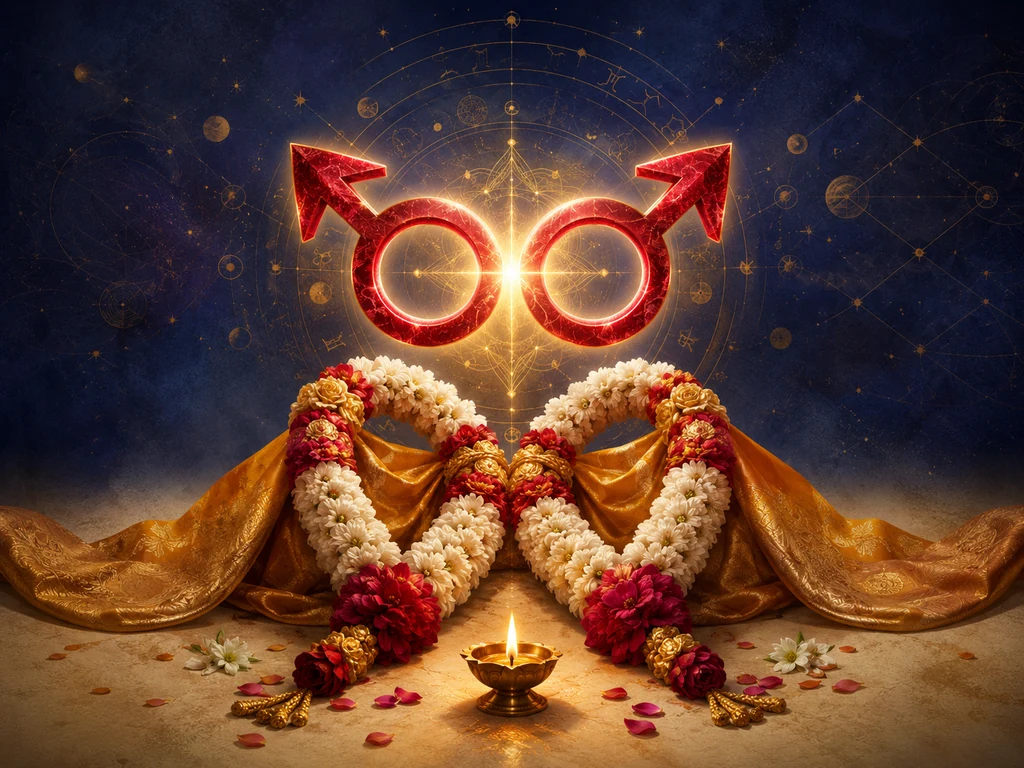
When two Mangliks marry, matching Mars patterns can reduce imbalance—but only after comparing severity, marriage factors, Navamsha, and timing carefully.
When two Mangliks marry, the traditional logic is that comparable Mars pressure in both charts can neutralise the mismatch that worries matchmakers. But it is not an automatic erasure of Manglik dosha: the two Mars placements must be compared for house, strength, aspects, sign, Navamsha support and the condition of marriage significators. In practice, “both are Manglik” is the beginning of judgement, not the verdict.
What does it mean when two Mangliks marry?
Manglik dosha is the matchmaking condition traditionally assigned when Mars occupies certain houses connected with self, family, home, marriage, vulnerability or the private life of a relationship. The most common working rule counts Mars in the first, second, fourth, seventh, eighth or twelfth house from the ascendant. Many lineages also repeat the count from the Moon, and some include Venus because Venus signifies affection, union and marital adjustment.
This variation matters. A person may be strongly Manglik from the ascendant and not Manglik from the Moon; another may qualify only through a secondary reference point. Calling both people “Manglik” without stating how the condition was derived hides the most important part of the analysis.
When both charts carry a genuinely comparable Mars pattern, traditional kundli matching treats the pair as more balanced than a Manglik–non-Manglik pairing. The idea is not that Mars vanishes. Rather, both people understand and express a similar level of heat, urgency, independence and directness. Their temperaments may be easier to match because one chart is not carrying all the martial pressure while the other is unusually soft or conflict-avoidant.
Why is Manglik dosha said to cancel between two people?
Marriage matching often works by balancing qualities rather than deleting planets. Mars represents initiative, courage, assertion, competition, injury, impatience and the capacity to act under pressure. In a marriage house or a house tied closely to domestic life, those qualities can become part of the relationship field.
If only one partner has a forceful Mars pattern, the couple may experience a recurring mismatch in pace and conflict style. One person presses for action while the other withdraws; one argues directly while the other experiences the same argument as aggression. When both have comparable Mars signatures, the energy is more mutually recognisable. This is the basis of the so-called cancellation.
“The useful question is not “Are both Manglik?” but “Do both charts carry Mars with a similar intensity, and can the rest of the marriage promise contain it?””
This principle is consistent with the broader classical method of judging planetary strength, house ownership, aspects and timing together. Brihat Parashara Hora Shastra does not reduce a chart to one placement; Parashari judgement depends on the planet, the house, its lord, associations and periods. Phaladeepika and Saravali likewise describe Mars in houses through a wider fabric of strength and condition. The specific slogan that “two Mangliks cancel each other” is better understood as a later matchmaking rule built on that larger logic, not as a universal classical sentence that overrides the horoscope.
Is Manglik cancellation complete or conditional?
It is conditional. Two people can both qualify as Manglik while carrying very different kinds of Mars.
Mars in the twelfth from the ascendant may show expenditure, restless sleep, private frustration or intensity in intimacy. Mars in the seventh acts more directly on partnership, negotiation and the spouse. Mars in the eighth may disturb trust, shared resources, in-law dynamics or the capacity to remain calm during crises. Mars in the fourth can heat the home environment; in the second it can sharpen speech and family conflict; in the first it colours temperament and directly aspects the seventh house.
These are not equivalent merely because they share one label. A mild twelfth-house Mars in a friendly sign, supported by benefic aspects, should not automatically be treated as equal to a severely afflicted seventh-house Mars that also damages the seventh lord and repeats in the Navamsha.
The strongest cancellation is therefore a close match of severity. Similar houses are helpful, but exact duplication is not required. What matters is whether the two charts show compatible levels of assertion and comparable protection around marriage.
How should Manglik dosha be read in both charts?
Begin from the ascendant because it describes the embodied life and the houses of the horoscope. Then repeat the check from the Moon to understand emotional reactivity. Venus may be used as a supplementary reference in traditions that follow it, but it should not replace the ascendant-based reading.
Next, assess Mars itself. Is it exalted, in its own sign, in a friendly or hostile sign, combust, retrograde, hemmed by malefics, joined Rahu or Ketu, or closely influenced by Saturn? Is Jupiter giving a full aspect? Is the dispositor of Mars strong enough to manage the planet? A strong Mars is not always gentler; it may simply be more capable of expressing its nature. The question is whether that strength becomes constructive courage or uncompromising force.
Then examine the exact marriage structure. The seventh house, seventh lord and Venus require attention in every chart. Jupiter is also important as a source of wisdom, ethics and protection, though its role should not be reduced to a gender formula. In Jaimini practice, the Upapada Lagna and darakaraka, the spouse significator, can confirm whether relationship strain is repeated. They do not create or cancel Manglik dosha by themselves, but they show whether Mars is part of a larger marriage difficulty.
Finally, check the Navamsha chart. There is no need to re-teach the entire divisional chart here: the essential point is repetition. If the natal chart shows Mars disturbing partnership and the Navamsha again weakens the seventh house or its lord, the concern gains weight. If the Navamsha is stable, the natal Mars may describe a fiery style that matures with experience rather than a broken marriage promise.
Which cancellation rules deserve the most weight?
The most reliable cancellation is equal or near-equal Manglik intensity in both horoscopes, combined with healthy marriage factors. A well-placed seventh lord, a supported seventh house, a strong but unafflicted Venus, and a stable Navamsha can substantially alter how Mars behaves.
Benefic influence on Mars or the seventh house also matters. Jupiter’s aspect can bring judgement, restraint and a willingness to act ethically, but it should not be advertised as a magical eraser. A benefic planet that is weak, afflicted or functionally difficult for the ascendant may offer less protection than a simplistic rulebook suggests.
Sign-based exceptions are used by many regional schools, especially when Mars occupies its own or exaltation sign, or when the relevant house and sign alter its functional expression. These exceptions should be treated as modifiers, not universal acquittals. The same caution applies to claims that a particular conjunction, nakshatra or planetary lordship cancels everything. A valid exception must improve the actual marriage structure, not merely satisfy a memorised formula.
The broad method of Phaladeepika is useful here: planets produce results according to strength, dignity, house, lordship and association. That is why a full birth-chart analysis is more dependable than a yes-or-no Manglik calculator.
What does a real two-Manglik match look like?
Consider a hypothetical chart used in consultation. Person A has Aries rising, with Mars at 14° Libra in the seventh house. The Moon is at 18° Aquarius, so Mars falls ninth from the Moon and does not repeat the condition from that reference. Person A is therefore Manglik primarily from the ascendant. Mars in the seventh makes relationship dynamics direct, fast and sometimes argumentative, but it is placed in Venus’s sign. Venus itself is at 22° Taurus in its own sign, giving the relationship significator substantial stability.
Person B has Cancer rising, with Mars at 12° Capricorn in the seventh house. The Moon is at 3° Taurus, so Mars again falls ninth from the Moon. Person B is also Manglik primarily from the ascendant. Here Mars is exalted, which makes it powerful, organised and capable of sustained action, but also potentially controlling when stressed. Jupiter at 10° Cancer in the ascendant aspects the seventh house, adding counsel and perspective. Venus at 9° Pisces is exalted.
At first glance, both have seventh-house Mars, so the matching principle is strong. Neither partner is bringing a mild secondary Manglik condition against the other’s severe partnership-focused Mars. Their charts recognise a similar need for decisiveness, independence and candour.
Yet the cancellation is not identical in quality. Person A’s Mars in Libra must negotiate through Venus and may fight over fairness, reciprocity or indecision. Person B’s exalted Mars in Capricorn may prioritise control, efficiency and results. The couple can still clash because one argues about balance while the other argues about execution. What improves the match is the strength of Venus in both charts and Jupiter’s protection in Person B’s chart. If the Navamsha also supports the seventh lords, I would read this as a workable high-energy marriage, not as two dangerous doshas colliding.
Now alter one fact: suppose Person A’s Venus were debilitated and joined Ketu in the sixth, while the Navamsha seventh lord were also afflicted. The phrase “both Manglik” would no longer be sufficient reassurance. Mars matching would remain a positive factor, but the wider marriage promise would need much more caution.
When does Manglik dosha actually give results?
A natal placement describes potential; timing determines when it becomes loud. Parashari astrology uses dasha, the planetary period system, to identify activation. Mars mahadasha or antardasha can bring Mars themes forward, especially when Mars owns or occupies relationship-sensitive houses. Periods of the seventh lord, Venus, planets placed in the seventh, or planets connected with the Navamsha seventh lord can also activate marriage events.
Transits act as triggers, not replacements for the natal chart. Saturn or the lunar nodes crossing the seventh house, aspecting Mars, or activating the ascendant–seventh axis may increase pressure, but no single transit creates Manglik dosha. Equally, there is no 2026 transit date that can decide whether two Mangliks should marry. The natal promise, dasha sequence and both partners’ charts must be read first; transit dates only refine the window.
This is why a couple can marry peacefully during a supportive Venus or seventh-lord period and encounter sharper adjustments later in a Mars period. It does not mean the original matching failed. It means the chart’s dormant conflict style has entered its active season.
What should two Mangliks do before marriage?
The best remedy begins with accurate diagnosis. Confirm the birth time, calculate both charts with the same ayanamsha and house method, and state clearly whether Mars qualifies from the ascendant, Moon or Venus. A professional relationship report should explain severity rather than placing a red stamp on the chart.
The couple should also discuss how each person handles anger, urgency, money, family boundaries, sexual expectations and domestic decision-making. This is not outside astrology; it is the behavioural expression of Mars. A chart may show heat, but self-awareness decides whether heat becomes courage, attraction and joint enterprise, or contempt and escalation.
Traditional remedies can be used when they suit the family’s practice: disciplined Tuesday worship, Hanuman or Subrahmanya devotion, charity connected with service and injury care, and conscious restraint in speech are common approaches. Ritual should support conduct, not substitute for it. Expensive ceremonies performed from fear are not evidence of better astrology.
Where the charts show serious repetition—an afflicted seventh house, damaged seventh lord, weak Venus, harsh Navamsha and difficult dashas—consult an experienced Vedic astrologer rather than relying on a score or app label. Astrology is best used for guidance and reflection; it is not a substitute for medical, legal, financial or mental-health advice.
When should you not worry about being Manglik?
Do not worry merely because an online calculator detected Mars in one of six houses. The placement may be secondary, weakly operative, well supported or irrelevant to the actual marriage promise. A person with Mars in the twelfth from the Moon alone is not automatically comparable to someone with Mars in the seventh from the ascendant, repeated in the Navamsha and tied to an afflicted seventh lord.
You should also avoid fear when the rest of the chart is strong. Good marriage yogas, stable lords, benefic influence, emotional maturity and compatible dashas can carry more weight than a single dosha label. Classical astrology is cumulative. No responsible practitioner predicts widowhood, divorce or danger from Manglik dosha alone.
Age-based claims also need caution. Some traditions say the dosha weakens after a particular age, but there is no single universally accepted threshold that cancels Mars for everyone. Maturity can improve behaviour, and later dashas can be gentler, but Mars does not disappear from the horoscope on a birthday.
Does Manglik dosha cause divorce?
Not by itself. Divorce requires a broader pattern involving the seventh house and lord, relationship significators, divisional confirmation and timing. Mars can describe conflict, impatience or strong autonomy, but the same Mars may support loyalty under pressure, sexual vitality, courage and the ability to build a life through decisive action.
A chart with Manglik dosha and strong marriage support can produce a durable union. A chart without Manglik dosha can still show separation through other combinations. The label is a screening tool, not a final prediction.
Can a Manglik marry a non-Manglik?
Yes, when the severity is mild, cancellation factors are genuine, and the non-Manglik chart can receive Mars without significant damage. The comparison should include temperament, seventh-house strength, Venus, the Moon, Navamsha and dashas. Rejecting every such match is not classical thoroughness; it is mechanical matching.
The reverse is also true: two Mangliks should not be approved automatically. If one chart carries severe repeated affliction and the other has only a nominal Mars placement, the mismatch remains.
Is Mangal dosha the same as Kuja dosha?
In ordinary matchmaking usage, yes. Mangala, Kuja and Mars refer to the same planet, so Manglik dosha, Mangal dosha and Kuja dosha usually name the same concern. Regional practice changes the counting rules and cancellation conditions, which is why the method must be stated before the result.
What is the final judgement when two Mangliks marry?
When two Mangliks marry, the shared Mars pattern can be a meaningful cancellation because it reduces asymmetry in temperament and relationship pressure. The cancellation becomes convincing when the source, house and severity of the dosha are comparable, and when the seventh house, seventh lord, Venus and Navamsha remain capable of sustaining marriage.
The phrase should never be used to bypass the rest of the horoscope. In the practitioner’s chair, I would rather approve a carefully balanced Manglik–non-Manglik match than a two-Manglik match with repeated damage to marriage indicators. Mars matching changes the equation, sometimes decisively, but the whole chart decides whether that change becomes compatibility.