Vimshottari Dasha: Why Timing Matters More Than Placement
Vimshottari dasha maps when a natal promise is most likely to unfold, using the Moon’s nakshatra to sequence planetary periods across a lifetime with precision.
A natal placement describes what a planet can promise; Vimshottari dasha describes when that promise is most likely to become active. This is why timing can matter more than placement: an excellent yoga may remain quiet outside the periods of its planets, while an apparently ordinary placement can become the centre of life when its period begins.
The dasha does not replace the birth chart. It turns the chart from a static diagram into a sequence, showing which planetary agenda has temporary authority and which parts of the horoscope are ready to produce results.
What is Vimshottari dasha?
Vimshottari dasha is a nakshatra-based timing system used widely in Parashari Vedic astrology. The Sanskrit word dasha means a condition, state or period. In practice, it refers to a span of life governed by a planet whose natal position, house ownership and relationships become especially consequential during that time.
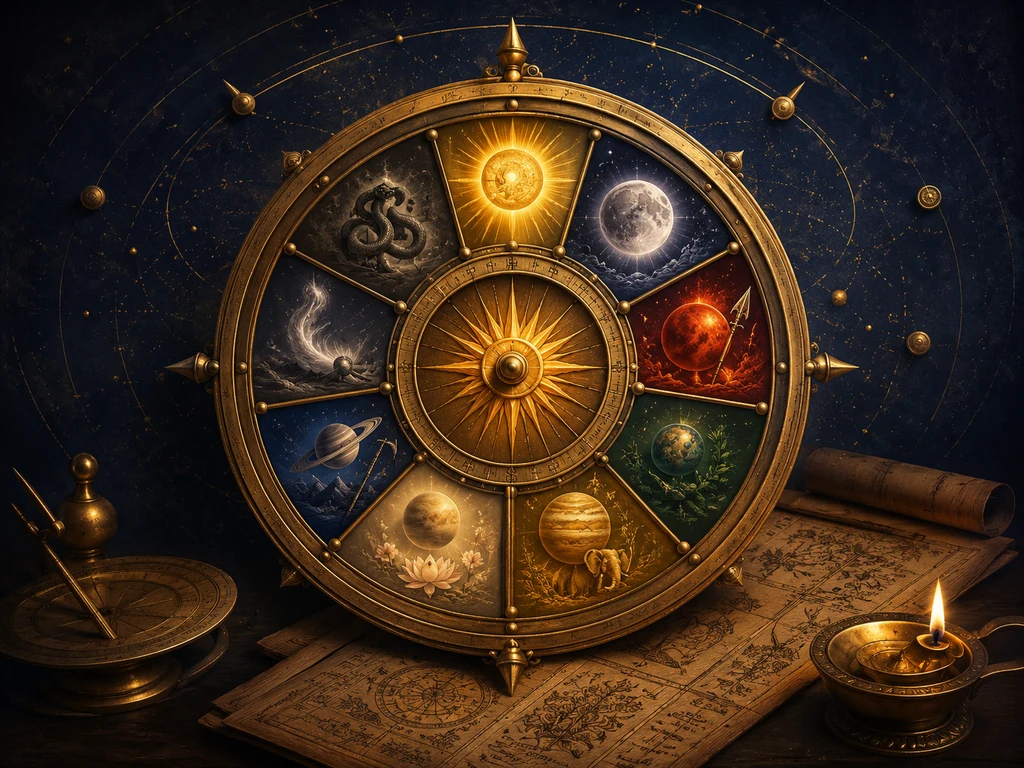
The system covers a theoretical cycle of 120 years. Its nine planetary periods run in the fixed order of Ketu for seven years, Venus for twenty, the Sun for six, the Moon for ten, Mars for seven, Rahu for eighteen, Jupiter for sixteen, Saturn for nineteen and Mercury for seventeen. After Mercury, the sequence returns to Ketu.
The cycle does not necessarily begin with Ketu at birth. The starting planet is determined by the nakshatra occupied by the natal Moon, and the portion of that nakshatra still remaining determines how much of the opening period is left.
The Brihat Parashara Hora Shastra presents Vimshottari among the principal planetary-period systems and gives extensive results for the major and subsidiary periods. Its underlying method is unmistakably Parashari: the period lord must be judged through house ownership, placement, strength, association and the houses it can activate.
Readers who need the full lunar framework first can consult our guide to the 27 nakshatras. Here, the important point is that the Moon’s birth position supplies the starting point of the life sequence; it does not, by itself, decide whether every period will be fortunate or difficult.
Why does timing matter more than a good or bad placement?
A planet may be strong in the horoscope without being continuously dominant. Consider an exalted or own-sign planet forming a favourable relationship with the ascendant lord. That placement remains part of the chart’s potential throughout life, but its most visible results are usually concentrated in its mahadasha, antardasha or in periods of planets closely connected with it.
The reverse is also true. A difficult placement does not produce uninterrupted trouble from birth to death. Its issues tend to become louder when the planet itself, its dispositor, its nakshatra lord or a strongly associated planet takes control of the timing sequence.
“Placement is the architecture of the horoscope; dasha is the clock that decides which room is being used.”
This is why experienced astrologers avoid describing a horoscope only through phrases such as “Jupiter in the tenth” or “Saturn in the seventh.” Those statements are incomplete until we ask when Jupiter or Saturn becomes active, what that planet owns for the ascendant, which subperiod is running, and whether current transits are supporting an event.
A strong planet can also bring demanding results. A powerful tenth-house lord may produce promotion, visibility and authority, but the same period may require heavier responsibility, relocation or reduced personal time. Strength means that a planet can act effectively; it does not mean that every experience will feel easy.
Likewise, a debilitated planet is not automatically powerless. Cancellation of debility, a strong dispositor, favourable aspects, divisional-chart support or beneficial house ownership may substantially alter its expression. Both Phaladeepika and Saravali judge planets through a combination of sign condition, house, association and strength rather than through one isolated label.
How is the first mahadasha calculated from the Moon?
Each nakshatra spans 13°20′ and belongs to one of the nine dasha planets. The planet ruling the Moon’s birth nakshatra becomes the first mahadasha lord. The fraction of the nakshatra still ahead of the Moon becomes the fraction of that planet’s period remaining at birth.
Take a concrete calculation: Moon at 18° Aquarius. This degree falls in Shatabhisha, which extends from 6°40′ to 20° Aquarius and is ruled by Rahu. The person is therefore born in Rahu mahadasha.
At 18° Aquarius, two degrees of Shatabhisha remain. Two degrees is 15 per cent of the nakshatra’s total span of 13°20′. Fifteen per cent of Rahu’s eighteen-year period is approximately 2.7 years, so the birth balance is about two years and eight months of Rahu mahadasha.
After that balance ends, Jupiter’s sixteen-year period begins, followed by Saturn’s nineteen-year period and then Mercury’s seventeen-year period. In this example, Saturn mahadasha would begin at roughly eighteen years and eight months of age and continue until approximately thirty-seven years and eight months, subject to the precise calculation convention used.
Professional software performs this calculation in arcminutes and accounts for the exact lunar longitude. The astrologer should still verify the birth data, ayanamsa and calculation settings. A Moon close to a nakshatra boundary can change the starting lord when the birth time is corrected, while even a smaller longitude adjustment can move the beginning or ending date of a period.
How do you read a mahadasha in a birth chart?
Begin with the planet’s functional role for the ascendant. Natural beneficence is not enough. Jupiter is naturally benefic, but its house ownership differs from one ascendant to another. Saturn is naturally stern, yet for Taurus and Libra ascendants it can own a trinal and an angular house, giving it an unusually constructive role when it is otherwise well placed.
Next examine the houses owned by the period lord. These houses identify the fields of life under administration. A lord of the second and fifth may connect wealth, speech, education, children and creative intelligence. A lord of the sixth and eleventh may emphasise employment, competition, obligations, gains, networks and the management of conflict.
Then judge the house occupied by the planet. House ownership describes what the planet carries; placement describes where it attempts to deliver those matters. A ninth lord in the tenth can connect higher learning, mentors, ethics or long-distance experience with vocation and public duty. A seventh lord in the twelfth may link partnership with distance, privacy, foreign residence or expenditure, but the final reading depends on dignity and supporting factors.
Sign strength, combustion, retrogression, planetary war, aspects, conjunctions and the condition of the dispositor must then be considered. A planet in its own sign usually has greater capacity to protect and organise its affairs. A planet in an inimical or debilitated sign may work through delay, correction or dependence on its dispositor.
The planet’s nakshatra lord adds another layer. A planet occupying a Mercury-ruled nakshatra often delivers part of its period through Mercury’s houses and condition. This does not erase the planet’s own lordship; it reveals the channel through which its results may be expressed.
Finally, confirm the theme in the relevant divisional chart. The D9 is important for the maturity and underlying strength of planets, while profession, children or property may require the appropriate specialised division. A single divisional placement should not overrule the complete birth chart, but repeated themes across the main and divisional charts deserve greater confidence.
What is the difference between mahadasha and antardasha?
The mahadasha is the long governing period. It establishes the broad chapter: which planet has executive authority, which houses remain persistently active and what kind of development the person is being asked to undertake.
The antardasha is the subsidiary period operating within that chapter. It narrows the focus by creating a temporary relationship between the major-period lord and the subperiod lord. The mahadasha sets the landscape; the antardasha identifies the actor currently moving through it.
The duration of an antardasha is proportional to the years assigned to its planet. For example, the Venus subperiod within Saturn mahadasha lasts approximately nineteen multiplied by twenty and divided by 120, or a little over three years. Its interpretation depends on the natal relationship between Saturn and Venus, their house ownership, placement, dignity and connections.
A Saturn–Venus period is therefore not universally favourable or unfavourable. For one ascendant it may unite a yogakaraka with the ascendant lord and support career consolidation. For another it may connect difficult houses and expose strain in finances or relationships. The names of the planets tell us which factors are active, not what verdict to announce.
The same principle continues into pratyantardasha and still smaller subdivisions. These layers can sharpen timing, but they should not be used to manufacture certainty. Our separate guide to antardasha inside antardasha explains how to use the nested periods without losing sight of the main chart.
A worked Vimshottari dasha example
Consider a simplified mini-chart with Taurus ascendant, Moon at 18° Aquarius, Saturn at 12° Capricorn and Venus at 24° Aquarius. The Moon is in Shatabhisha, so the person begins life with about two years and eight months of Rahu mahadasha. Jupiter follows for sixteen years, and Saturn mahadasha begins near age eighteen years and eight months.
For Taurus ascendant, Saturn owns the ninth and tenth houses. It therefore connects fortune, higher education, teachers, principles and long-distance experience with profession, authority and public responsibility. Because Saturn is placed in its own sign Capricorn in the ninth house, it has substantial capacity to deliver its natal agenda.
This does not mean nineteen effortless years. Saturn’s method remains gradual, accountable and consequence-oriented. The period may bring formal education, entry into a structured profession, contact with senior institutions, responsibility toward a father or mentor, relocation for work, or a career built through credentials rather than sudden popularity.
The Moon in the tenth house adds public visibility and responsiveness to changing professional conditions. As the third lord placed in the tenth, it can also connect communication, writing, media, sales, technical skill or self-directed effort with career. Because the Moon occupies Rahu’s nakshatra, Rahu’s placement would need examination before predicting how smoothly that visibility develops.
Venus, the Taurus ascendant lord, is also in the tenth house. During Saturn–Venus antardasha, the period links the ninth and tenth lord Saturn with the ascendant lord Venus in the career sector. This can be a strong window for assuming a recognised role, improving professional presentation, entering a significant contract or aligning work more closely with personal identity.
Yet Venus also rules the sixth house for Taurus. The same Saturn–Venus period may bring heavier workloads, staff management, competitive examinations, employment disputes or a health routine forced by professional pressure. The correct reading is not “promotion” alone. It is a period in which professional development, service, responsibility and personal direction become tightly connected.
Suppose a supportive Jupiter transit then aspects the tenth house or one of the period lords. That transit may help an existing career promise become an event. If a restrictive transit simultaneously affects the Moon, the promotion may still occur but with relocation, emotional pressure or reduced flexibility. Dasha establishes the active promise; transit helps describe the immediate trigger and circumstances.
This example shows why two people with Moon in Shatabhisha will not live the same Rahu, Jupiter or Saturn periods. The sequence may be identical, but the planets govern different houses and occupy different conditions in each horoscope.
How do transits work with Vimshottari dasha?
Transits are most reliable when they activate what the running dasha has already made relevant. A Jupiter transit cannot guarantee marriage merely because it crosses the seventh house. Marriage becomes more plausible when the mahadasha and antardasha connect the seventh house, its lord, Venus, the D9 or other relationship factors, and the transit then stimulates the same network.
Similarly, a Saturn transit through the tenth does not automatically cause career loss. During the period of a strong tenth lord, it may formalise authority or increase workload. During a period connecting the sixth, eighth or twelfth houses, the same transit may coincide with restructuring, exhaustion or a necessary change of direction.
Vimshottari dates are personal, so this subject is not tied to one universal 2026 forecast. A major transit occurring in 2026 will matter differently for every chart according to the planetary period running on the exact date. This is why a general annual horoscope and a birth-specific dasha analysis answer different questions.
When does a dasha produce its strongest results?
A period often becomes conspicuous near its beginning because the governing agenda changes, but the transition is not always instantaneous. The outgoing planet may continue to show consequences while the incoming planet gradually establishes its themes. Major changes can cluster around the dasha boundary, especially when transits also activate both lords.
Results may become clearer in the antardasha of the mahadasha lord itself, in the subperiod of a strongly connected planet, or when the mahadasha lord’s dispositor takes a subperiod. A planet may also produce significant events through the periods of planets occupying its houses, aspecting it or exchanging signs with it.
The commencement chart of a dasha can be studied as an additional timing layer, and BPHS discusses the condition of the period lord at the opening of its period. This method should refine the natal promise rather than overwrite it. A favourable commencement cannot create a marriage, inheritance or profession that has no credible foundation in the birth chart.
What should you do during a difficult planetary period?
The first task is to define what is actually difficult. A Saturn period may feel slow because it is demanding durable structure. A Mars period may create conflict because boundaries, competition or decisive action have been postponed. A Mercury period may become scattered when the person accepts too many commitments. Naming the planet is less useful than identifying the behaviour and life area it is activating.
Practical action should match the chart. A sixth-house emphasis may call for disciplined health care, debt management, skill development or better workplace systems. An eighth-house emphasis may require reserves, insurance, therapy, research, succession planning or acceptance of a transition that cannot be controlled through speed.
Traditional practices such as mantra, worship, charity, fasting or service may be undertaken according to one’s faith and under competent guidance. They are best understood as disciplines that cultivate steadiness, responsibility and perspective—not as payments made to frighten a planet into silence.
A well-prepared personal astrology report should distinguish between a genuine high-pressure period and ordinary astrological noise. Consultation with an experienced Vedic astrologer is most useful when it clarifies choices and timing rather than creating dependency.
Astrology is a tool for guidance and reflection. It is not a substitute for medical diagnosis, legal advice, financial planning or other qualified professional care.
What are the biggest myths about Vimshottari dasha?
“A benefic planet always gives a good mahadasha.” Natural beneficence is only one factor. House ownership, dignity, placement, association and the condition of the dispositor can turn a supposedly gentle planet into the administrator of demanding houses.
“A malefic planet always causes loss.” Mars and Saturn can produce discipline, technical competence, property, leadership, endurance and professional authority when they are functionally constructive and well placed. Their periods may be strenuous without being destructive.
“The mahadasha lord gives only the results of its occupied house.” It can activate its owned houses, occupied house, planets joined or aspected, its dispositor, its nakshatra lord and relevant divisional-chart themes. Reducing all of that to one house is rarely adequate.
“Every event can be predicted to the exact day.” Smaller dasha subdivisions, transits and event charts can narrow a window, but birth-time uncertainty and interpretive limits remain. Precision should increase humility, not theatrical certainty.
“A difficult dasha means nineteen or twenty bad years.” Long mahadashas contain many antardashas. The tone, subject and intensity change repeatedly within them. Even a demanding major period can contain productive, joyful and restorative phases.
FAQ: questions people ask about Vimshottari dasha
Which is the best mahadasha?
There is no universally best period. The most productive mahadasha is usually one whose lord is capable of supporting the chart’s important houses, is reasonably strong, and forms useful relationships with the ascendant, trinal or angular lords. Even then, “best” depends on whether the person is asking about health, marriage, vocation, wealth or spiritual practice.
Is Vimshottari dasha read from the Moon or the ascendant?
The opening period and balance are calculated from the Moon’s nakshatra. Interpretation, however, requires the entire horoscope, especially the ascendant and planetary house ownership. Calculating from the Moon and interpreting without the ascendant are not the same thing.
Can the same mahadasha return twice in one life?
The complete sequence is 120 years, so most people do not experience a second full period of the same planet. Someone born with only a small balance of the first mahadasha may reach that planet again at a very advanced age after the rest of the cycle has passed.
Can a mahadasha cause an event not shown in the natal chart?
It should not be expected to create a major result without natal support. A period activates and develops existing planetary promises. Timing systems are strongest when several independent chart factors point toward the same subject.
Why do two astrology programs show different dasha dates?
Differences can arise from the ayanamsa, birth-time handling, lunar position, calendar-year convention and other software settings. Large discrepancies should be investigated rather than averaged. Use one clearly stated calculation standard throughout an interpretation.
Should Vimshottari be combined with Jaimini dashas?
It can be compared with Jaimini sign-based systems when the astrologer understands both methods independently. Agreement between distinct systems can strengthen confidence, but rules should not be mixed casually. Parashari planetary periods and Jaimini rashi dashas operate from different structures and must first be judged on their own terms.
The real value of the dasha clock
Vimshottari dasha matters because life does not express every part of a horoscope at once. The birth chart contains many valid possibilities—education and profession, partnership and solitude, gain and expenditure, stability and change. The running planetary periods arrange those possibilities into chapters.
The mature question is therefore not simply, “Is this planet good?” It is: What does this planet govern in this chart, how capable is it of acting, which planet is modifying it now, and what is the appropriate response to the season it has opened?
That is the difference between naming placements and practising astrology as a discipline of time.