The Lo Shu Grid: What Missing Birth-Date Numbers Reveal
A missing number in the Lo Shu grid points to a quality that needs conscious development—not a flaw, curse, or fixed prediction about your future path.
The missing numbers in a Lo Shu grid show qualities that may not operate automatically in a person’s life. They are best read as developmental themes—areas where habit, education, experience, or conscious effort may be needed—not as defects or fixed predictions. An absent number can become highly visible precisely because life repeatedly asks the person to build what was not naturally supplied.
What is the Lo Shu grid, and how does it work?
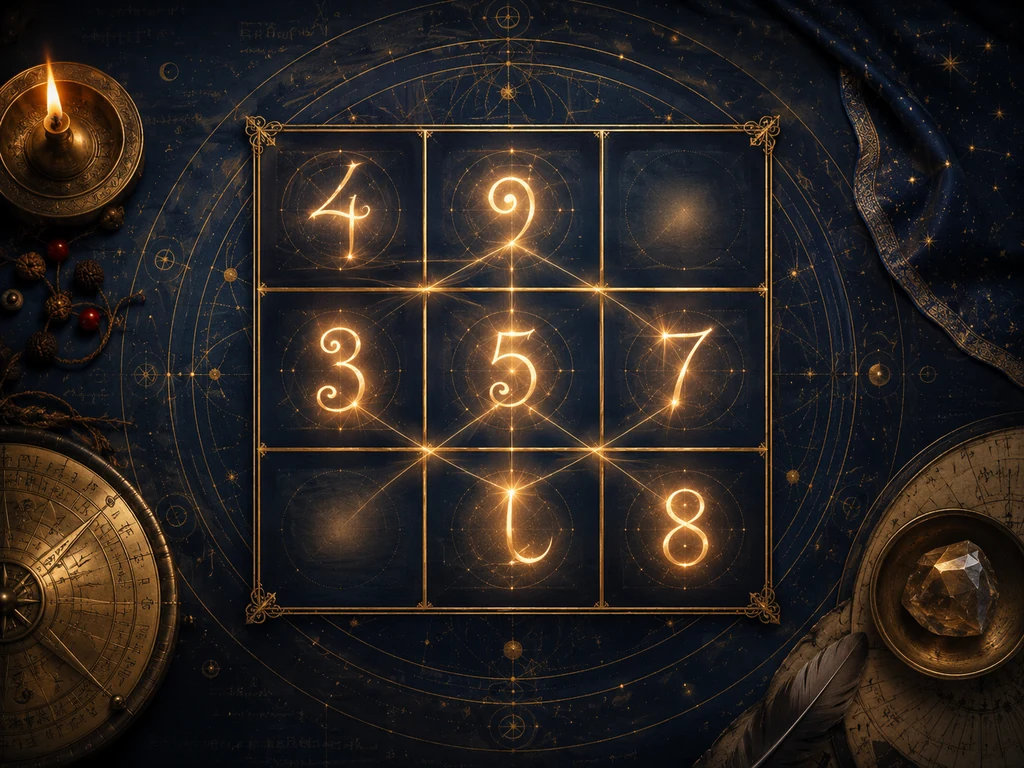
The Lo Shu grid is a three-by-three arrangement of the numbers one to nine. In its standard form, the top row is 4–9–2, the middle row is 3–5–7, and the bottom row is 8–1–6. It is also a magic square: every row, column, and main diagonal totals fifteen. The arithmetic is established mathematics; using a birth date to create a personality chart is a numerological practice built around that structure. The Encyclopaedia Britannica explanation of magic squares helps separate the square’s mathematics from later interpretation.
The Luo Shu belongs to Chinese cultural and cosmological history and later became important in Compass School Feng Shui. Academic discussion treats it as a matrix used in traditional spatial and temporal systems; the modern birth-date chart is one interpretive branch of that wider legacy. A study in SAGE Open describes the Luo Shu as foundational to Compass School methods.
To create a birth date grid, place every non-zero digit of the date into its fixed cell. A person born on 27 April 1985 contributes 2, 7, 4, 1, 9, 8, and 5. Zero is normally omitted because the grid contains only one through nine. Each digit remains in its own position; it is not reduced or moved.
This distinction matters. A Lo Shu chart records presence, absence, and repetition. A birth number or life-path calculation reduces digits to a root number. The tools can be read together, but they answer different questions. See our guide to the birth number and life path number for the reduction method.
How do you read a Lo Shu chart correctly?
Begin with what is observable: which numbers appear, which are absent, and which repeat. A present number describes a quality that is readily available. Repetition intensifies that quality, though intensity is not the same as maturity. A missing number suggests that the corresponding function may require deliberate development.
Then read the geometry. Three present numbers forming a row, column, or diagonal create a connected pathway. Schools give these pathways different names, so a careful reader should describe the structure before attaching a grand label. A complete 4–9–2 line, for example, joins order, broad vision, and sensitivity. An incomplete line does not mean that the whole area fails; it means one part of the pathway needs support.
Context matters more than a single gap. Missing 1 means something different when 2, 5, and 8 are strong than when the chart contains only two or three digits. A repeated 1 may compensate for hesitation in expression, but it may also create over-insistence on one’s own position. The practitioner’s job is not to praise present numbers and frighten the client about absent ones. It is to judge balance.
“A missing number is not an empty fate; it is a part of the personality that usually develops through practice rather than instinct.”
What does each missing number in the Lo Shu grid mean?
Missing 1 points to lessons around self-expression, initiative, and speaking from one’s own centre. The person may know what they feel but struggle to state it directly, or wait for permission before acting. Strong 3, 5, or 9 can still produce an articulate person who finds it difficult to say, “This is what I want.” The practical task is clear communication without defensiveness.
Missing 2 can show that emotional receptivity, cooperation, or patient listening needs cultivation. Such a person may care deeply yet miss subtleties in tone or timing. In relationships, the issue is often not lack of love but lack of attunement. A compatibility reading should never reject a match because one partner lacks 2; the useful question is whether both people can listen, repair, and adjust.
Missing 3 often concerns expression through ideas, planning, memory, or creative organisation. The person may have insight but present it in fragments, postpone learning, or skip the sequence that helps others follow. The remedy is not to become “more talented.” It is to structure thought, write things down, and complete the middle stages of a task.
Missing 4 highlights discipline, method, routine, and practical containment. The person may resist repetitive systems, begin enthusiastically, and then lose consistency. It can also appear in flexible, inventive people who dislike rigid procedure. The mature expression is not obsessive scheduling; it is enough structure to make inspiration repeatable.
Missing 5 deserves attention because 5 occupies the centre. Its absence can indicate difficulty integrating competing demands or returning to equilibrium after disruption. The person may swing between extremes, absorb the mood of the environment, or decide only after pressure builds. This is not a promise of instability. It suggests that pauses, grounding, and clear decision rules are especially useful.
Missing 6 often brings lessons around responsibility, continuity, home, caregiving, and commitment. Some people avoid obligation; others overcompensate by carrying everyone. The distinction appears only through life history. The real question is whether responsibility is chosen, shared, and sustainable. Missing 6 should never be used to predict divorce, infertility, or family loss.
Missing 7 may show that reflection, trust in experience, patience with uncertainty, or inward learning develops slowly. The person may prefer immediate evidence and practical action, or repeat an experience before extracting its lesson. This does not make anyone unspiritual. Spirituality is too large to be assigned to one cell. The useful task is making enough silence to digest experience.
Missing 8 commonly concerns material stewardship, long-range endurance, authority, and the disciplined use of resources. The person may avoid money, boundaries, status, or power, or pursue visible success without stable systems underneath it. Missing 8 does not predict poverty. It asks for financial literacy, patience, and a healthier relationship with accountability.
Missing 9 can indicate that broad perspective, idealism, completion, or social vision is not automatic. The person may focus closely on immediate needs and overlook wider consequences, or struggle to release work and relationships after their purpose has ended. The developmental task is to connect personal action with a larger meaning without becoming grandiose.
Why do repeated numbers matter as much as missing ones?
Repetition increases volume. Two 1s may strengthen personal expression; three or four can make expression urgent, blunt, private, or difficult to regulate, depending on the rest of the chart. Repeated 2s can deepen sensitivity but also emotional permeability. Repeated 4s may support order while hardening into rigidity. Presence is not automatically virtue.
Repetition also changes the meaning of absence. Someone with missing 4 and repeated 3 may generate ideas faster than systems can hold them. Someone with missing 2 and repeated 1 may speak quickly and listen late. Someone with missing 8 and repeated 6 may give generously but avoid pricing, saving, or limits. This relational reading is more useful than nine isolated definitions.
Complete lines deserve similar caution. A full line shows that three functions can cooperate, but it does not guarantee worldly success. An empty line may describe a recurring lesson, yet many dates naturally leave several cells blank. The birth date grid is sparse by design. Missing numbers are normal, not rare anomalies.
Worked example: how is a birth date placed in the grid?
Take a person born on 27 April 1985. We write 27-04-1985 and omit zero. The remaining digits are 2, 7, 4, 1, 9, 8, and 5.
In the Lo Shu chart, 4 occupies the top-left cell, 9 the top-centre, and 2 the top-right. The middle row has an empty 3 cell, 5 in the centre, and 7 on the right. The bottom row has 8 on the left, 1 in the centre, and an empty 6 cell. Numbers 3 and 6 are missing; every other number appears once.
The first conclusion is not “bad communication and bad family life.” That would be careless. Missing 3 suggests that organised expression, sequencing, study habits, or converting ideas into a clear plan may need work. Missing 6 suggests that sustained responsibility and the everyday maintenance of commitments may also require deliberate structure.
Now examine the complete pathways. The 4–9–2 top row is present, linking method, broad perspective, and receptivity. The 9–5–1 central column connects vision, balance, and self-expression. The 2–5–8 diagonal connects sensitivity, centred judgement, and practical endurance. These pathways substantially soften the interpretation of the two missing numbers.
From the practitioner’s chair, I would ask whether this person sees the whole situation quickly but delays writing the plan, documenting the process, or maintaining the routine. I would also ask whether they accept major responsibility but dislike the small recurring duties that keep a home, team, or project stable. If the life history confirms this, the reading is useful. If it does not, we do not force the person into the symbol.
The date reduces to 36 and then 9, giving a life-path emphasis on completion or broader contribution in many numerology schools. That does not alter the physical grid. Root-number reduction and grid placement remain separate techniques. A full numerology report should synthesise them rather than stack disconnected labels.
When do missing numbers become active?
The natal Lo Shu grid is not a complete timing system. It is a static map made from the birth date. Claims that a missing number must cause trouble at one fixed age are usually school-specific and should not be presented as universal law.
Timing is commonly added through personal-year, personal-month, or related cycles. When a yearly vibration repeats a missing number, a practitioner may read that period as an invitation to work consciously with its themes. A person missing 4, for instance, may enter a period requiring systems, paperwork, routines, property management, or disciplined effort. This is symbolic timing, not certainty that a particular event must occur.
Vedic astrology uses a different timing architecture. Dashas and transits are judged from the horoscope, not imported from a Lo Shu chart. A Saturn period may emphasise responsibility, and missing 6 may describe how someone responds to responsibility, but the systems do not share one classical rule. For astrological timing, begin with the janam kundli and consult a qualified practitioner through our astrologer directory.
No universal 2026 transit date is required to interpret a natal Lo Shu grid. Adding current planetary dates merely to sound timely would confuse techniques rather than improve accuracy.
What should you do about missing numbers?
The soundest remedies are behavioural. Missing 1 benefits from direct requests and decisions; missing 2 from listening and emotional vocabulary; missing 3 from writing and planning; missing 4 from repeatable routines; missing 5 from pauses and grounding; missing 6 from fair responsibility; missing 7 from reflection; missing 8 from budgeting and boundaries; and missing 9 from completion and wider purpose.
These practices remain useful even for someone who treats numerology as symbolic rather than literal. They turn the chart into a reflective tool instead of a source of anxiety.
Objects, colours, crystals, directional placements, phone numbers, and name changes belong to particular remedial schools. They should not be sold as guaranteed corrections. Adding a number to a phone does not alter the birth date. At most it becomes a chosen symbol or reminder. The stronger remedy is lived behaviour.
Is the Lo Shu grid part of Vedic astrology?
No. The Lo Shu grid is not taught in Brihat Parashara Hora Shastra (BPHS), Phaladeepika, Saravali, or the Jaimini tradition. Those classical systems judge grahas, signs, houses, aspects, strengths, yogas, divisional charts, and periods. They do not teach the modern placement of birth-date digits into the Chinese magic square.
The classics do offer a methodological lesson: no single factor should be read alone. BPHS builds judgement from interacting factors such as lordship, placement, strength, aspect, and period. Phaladeepika and Saravali likewise state results conditionally, with dignity and context changing the outcome. We can borrow that discipline without inventing a Vedic origin for Lo Shu numerology.
A practitioner may use both systems, but should identify which statement comes from which tradition. Calling every number-planet correspondence “Vedic” weakens the reading rather than strengthening it.
What are the biggest myths about missing numbers?
The first myth is that more gaps mean a worse life. Most dates leave several cells empty. A sparse chart may describe someone who develops through experience, while a full chart may contain competing tendencies that still require integration.
The second myth is that one absence predicts a specific calamity. Missing 6 does not prove marital failure. Missing 8 does not prove financial struggle. Missing 7 does not prove lack of spirituality. Upbringing, education, culture, opportunity, and choice all shape expression.
The third myth is that repeated numbers are automatically lucky. Excess can be as difficult as absence because an available quality may become the person’s overused default response.
The fourth myth is that a Lo Shu chart can replace a horoscope, psychological assessment, financial plan, or medical diagnosis. It cannot. Astrology and numerology are best used for guidance and reflection, not as substitutes for medical, legal, mental-health, or financial advice.
Can a missing number appear later in life?
The natal chart does not change because the birth date does not change. The person’s capacity can change greatly. Someone missing 4 may become exceptionally disciplined because circumstances demanded it. The absence then describes the route of development, not the final level of achievement.
Does zero count in the Lo Shu grid?
In the common birth-date method, zero is omitted because the traditional square contains one through nine. Some modern schools assign zero a separate meaning, but that is an added convention and should be stated openly rather than blended into the standard chart.
Is one missing number more serious than another?
No number is universally the worst to miss. The centre number 5 receives special attention because of its structural position, but even missing 5 must be judged with the remaining numbers and the person’s actual life. Severity language usually creates fear without improving accuracy.
Can marriage compatibility be judged from two Lo Shu grids?
Two charts can show where partners naturally understand or compensate for each other, but they cannot establish the quality or durability of a marriage alone. Communication, values, safety, maturity, and conduct matter more. In traditional Jyotisha, marriage judgement requires the natal charts, seventh house and lord, relevant significators, Navamsha, dashas, and broader compatibility factors—not one missing digit.