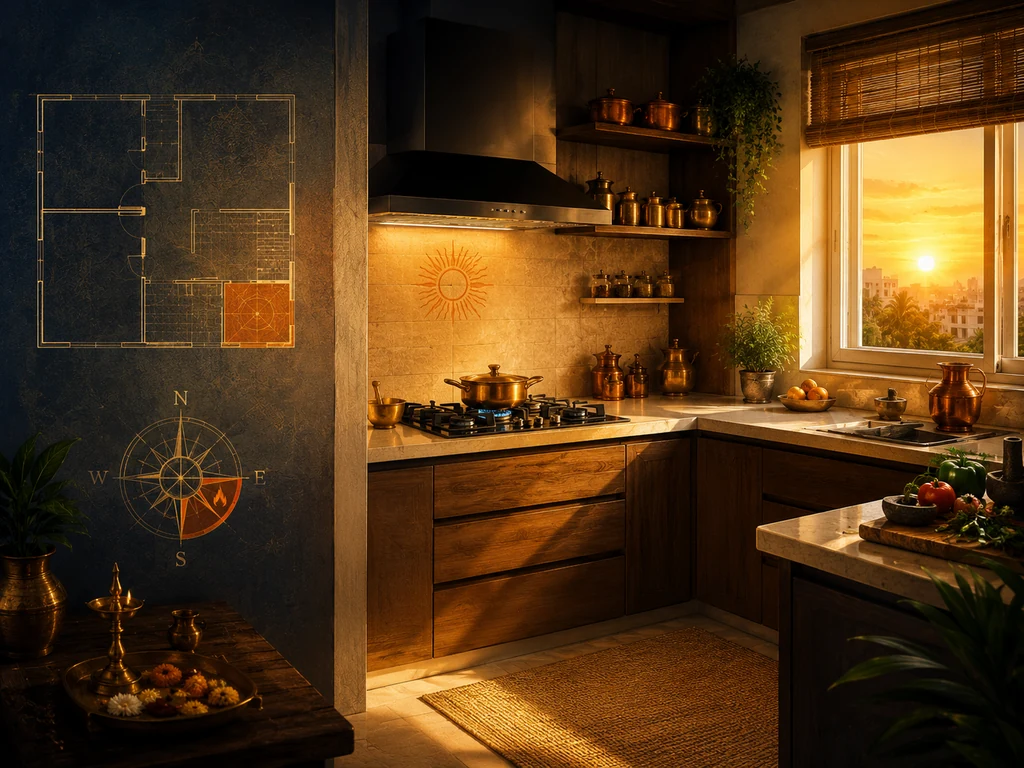
South-East Kitchen Vastu: The First Fix Worth Making
A south-east kitchen aligns cooking fire with Vastu’s fire quarter. Learn stove placement, safe alternatives, chart timing and practical remedies for flats.
The south-east is the preferred kitchen direction because Vastu assigns this quarter to controlled fire, heat, transformation and the preparation of food. When the kitchen, stove and cooking activity are placed there sensibly, the house gives fire a defined zone instead of allowing it to compete with areas meant for rest, water, worship or stability.
That is why the south-east kitchen Vastu rule is often the first correction worth considering. It affects an activity repeated every day, yet it can frequently be improved without rebuilding the entire home.
Why does Vastu place the kitchen in the south-east?
The south-east is traditionally called Agneya, the fire quarter. After introducing that term, the principle is simple: activities that produce flame, high heat, smoke and rapid transformation belong in the fire zone of the dwelling.
Cooking is not merely storage or dining. Raw ingredients are cut, heated and transformed into nourishment. A traditional kitchen also contained a hearth that remained active for substantial periods, making its location more consequential than the placement of occasional furniture.
Practical Vastu manuals therefore prefer the kitchen in the south-east and commonly advise the cook to face east. The same tradition places ovens, furnaces, generators and other heat-producing equipment in or near the south-east when the nature of the building permits it. A published compilation of traditional guidelines explicitly recommends the south-east kitchen, east-facing cooking and a north-east position for the sink within the kitchen.
This does not mean that every centimetre of the south-east must contain fire. It means that the fiery function of the home should be concentrated in that quarter, while water, storage and movement are arranged so they do not obstruct it.
“The strongest Vastu correction is usually not decorative: it is giving a daily function the direction most suited to its nature.”
Is the south-east rule symbolic or practical?
It is both, but the practical layer should never be ignored. The symbolic model places fire in the south-east; good architecture must still provide ventilation, daylight, safe fuel connections, workable counters, drainage and sufficient distance between flame and water.
A kitchen that is technically in the south-east but traps smoke, overheats badly or creates a fire hazard is not a successful kitchen. Vastu does not excuse poor construction. Traditional planning worked through the actual behaviour of space: openings, circulation, weight, heat, water and use were considered together rather than treated as isolated superstitions.
Texts associated with classical Indian architecture cover far more than directional symbolism. Works such as P. K. Acharya’s study and translation of the architectural Mānasāra discuss orientation, measurement, site planning and building form as parts of one discipline. This wider context matters because a directional rule becomes meaningful only when the house functions well as a whole.
The south-east preference is therefore best understood as a planning hierarchy. First place the kitchen in the fire quarter when possible. Then ensure that the stove, water source, storage, doors and windows support safe cooking.
How do you find the real south-east of a house?
Begin with the usable footprint of the residence, not merely the direction in which the main door faces. An east-facing home does not automatically have an east-facing kitchen, and a south-facing apartment can still contain an excellent south-east kitchen.
Stand at the approximate geometric centre of the enclosed home and determine true directions with a reliable compass. Keep away from large metal appliances, electrical panels and reinforced structural members while taking readings, because they may disturb a phone compass. Compare readings at several points rather than trusting one measurement.
Next, sketch the house as a simple rectangle or the closest practical shape. Mark north, east, south and west, then identify the corner between south and east. For a regular plan, the south-east sector is straightforward. For an irregular flat, extended balcony or cut corner, the assessment should be based on the main enclosed mass of the dwelling rather than on a tiny projection.
A full directional-grid method is explained separately in the [Vastu direction and house-grid guide]. It is better to use that method once than to keep redefining directions according to the position of individual rooms.
The location of the building within a larger plot and the location of the kitchen within the apartment are separate levels of analysis. In a multistorey block, residents usually have control only over the internal unit. The practical reading should therefore begin with the boundaries of the actual home they occupy.
What counts as a properly arranged south-east kitchen?
The kitchen room should ideally fall substantially within the south-east sector, but the stove is the decisive object. Even when the room overlaps east or south, placing the cooking flame toward its south-east portion often preserves the essential logic.
The cook traditionally faces east. This usually requires the stove to stand against or near the eastern side in a suitable counter arrangement, although the exact wall depends on the plan. Some traditions also accept facing south where an east-facing position cannot be designed safely. Facing east remains the cleaner first preference in most household layouts.
Water should not be crowded immediately against the stove. The sink, filter and major water storage are better placed toward the north or north-east side of the kitchen when plumbing permits. This is not a command to create an impractical room. A modest, usable separation between sink and flame is more meaningful than installing symbolic partitions or coloured tape.
Heavy provisions, grain containers and tall cabinets generally sit more comfortably along the southern or western sides. Windows or exhaust openings should remove heat without forcing the cook into an awkward position. A refrigerator may be accommodated according to available space, provided it does not block circulation or press directly against the stove.
The traditional guideline recommending the south-east kitchen, east-facing cook, north-east sink and southern or western storage walls illustrates this functional division inside the room itself.
What if the kitchen is not in the south-east?
A kitchen outside the south-east is not an automatic declaration of family trouble. The seriousness depends on which direction it occupies, where the stove stands, how often the kitchen is used and whether the broader house is reasonably balanced.
The north-west kitchen is the most workable alternative in many Vastu traditions. The north-west is associated with movement and circulation, qualities that can support the preparation and distribution of food. Such a kitchen may feel busier or require more attention to routine, but it is not ordinarily treated with the same concern as fire placed in a highly incompatible zone.
A west kitchen can also function adequately when the stove is arranged thoughtfully and ventilation is strong. A kitchen extending into the south may be manageable, particularly when the actual flame remains toward the south-east side of the room.
The north-east deserves greater caution because it is traditionally kept lighter, cleaner and quieter. Placing intense heat, grease and heavy kitchen storage there reverses the intended quality of that corner. Even so, occupants should not panic or assume that every difficulty comes from the kitchen. Begin with the stove location, cleanliness, ventilation and separation of fire from water before considering structural work.
A kitchen near the centre of the house is generally undesirable in both symbolic and practical terms. Central heat and smoke can spread into several rooms, and extraction may be harder. Yet safety and architectural reality still take priority: never move an active flame into a poorly ventilated corner merely to satisfy a compass reading.
How is kitchen Vastu read in a birth chart?
The floor plan tells us whether the kitchen suits the house. The birth chart tells us how strongly a person may experience themes of home, food, comfort, property and domestic reorganisation. These are connected layers, but they are not interchangeable.
In Parashari astrology, the fourth house is examined for residence, domestic happiness, land and the experience of home. Brihat Parashara Hora Shastra explicitly places houses, lands and residential comfort under the fourth house and judges results through the strength of the house, its lord and relevant influences.
The Moon is considered for emotional ease, habits and nourishment. Mars is relevant to heat, cutting, flame and decisive physical action. Venus contributes comfort and aesthetic usability, while the second house describes food, family resources and what is taken into the mouth.
Phaladeepika and Saravali also interpret planets according to their natural qualities and their placement in domestic houses. They support a layered judgement: no responsible astrologer should predict the quality of a home from Mars alone, the Moon alone or one afflicted house alone.
For a personal reading, examine the fourth house and its lord, the Moon, Mars, the second house, the fourth-house divisional context and the periods currently active. The chart may show that renovation, relocation or domestic conflict is more noticeable at a certain time. It cannot change the physical fact that a room lies north-east or south-east.
This distinction prevents an increasingly common error: using the horoscope to excuse a poor layout or using a Vastu defect to replace a complete horoscope analysis. A proper kundli reading should confirm patterns through several factors before any conclusion is made.
Worked example: a strong Mars and a misplaced stove
Consider a Capricorn ascendant with Moon at 18° Aquarius in the second house and Mars at 14° Aries in the fourth house. Mars owns the fourth house and occupies its own sign, giving considerable strength to property, construction, initiative and the desire to control the physical environment of the home.
This placement does not mean the native must have arguments in the kitchen. Mars is strong rather than inherently ruined. It may show a person who renovates decisively, prefers functional spaces, takes charge of repairs or is unusually sensitive to heat, noise and disorder at home.
Now consider the actual flat. The kitchen occupies the north-east room. The stove is fixed on its western counter, so the cook faces west. The sink touches the stove counter, and a large overhead cabinet makes the room dark. The south-east room is used as a lightly occupied utility and storage room.
The floor plan presents the primary issue: intensive fire has been placed in the lighter north-east, while the natural fire quarter holds inactive clutter. The horoscope adds timing and temperament. During a Mars major or sub-period, or during a period strongly activating the fourth lord, the resident may become more determined to renovate, argue over the layout or invest in property improvements. Mars does not create the compass defect; it makes the domestic issue more active in the person’s life.
The best correction would be to convert the south-east utility area into the working kitchen if plumbing, structure, ownership and cost allow. If that is unrealistic, the next correction is smaller: shift the stove toward the south-east part of the existing kitchen, create safe distance from the sink, brighten the room, improve extraction and reduce heavy storage in the north-east.
The Moon at 18° Aquarius in the second house suggests that food habits may be somewhat irregular, individualistic or shaped by changing schedules. That observation may help the astrologer discuss routine and shared meals, but it does not justify frightening predictions about health or family stability.
This is how the two systems should cooperate. The plan identifies the spatial imbalance; the chart describes the resident’s pattern of response and the periods in which change is more likely.
When is the right time to make a kitchen Vastu correction?
Small operational corrections can be made as soon as they are safe. Cleaning an exhaust, repairing a burner, separating water from flame, reducing clutter or changing the direction of a portable induction unit does not require waiting months for a perfect date.
Structural relocation is different. Moving gas lines, plumbing, walls or electrical loads should be coordinated with competent professionals. Once a practical construction schedule has been chosen, a suitable electional time may be selected through the Panchang, especially for the first use of a newly built stove or kitchen.
A natal period connected with the fourth lord, Mars, Moon, second house or property-giving combinations may coincide with renovation. Transits can trigger what the birth chart already promises, but they should not be used as isolated commands.
There is no special 2026 transit that changes the permanent directional rule. A south-east kitchen does not become unsuitable because Jupiter or Saturn changes signs, and a north-east kitchen does not become ideal for a few months because of a favourable transit. Yearly astrology may help with the timing of expenditure, relocation or construction; it does not redraw the compass.
For a major purchase or renovation, the individual horoscope, ownership situation and construction calendar should be considered together. A consultation with experienced Vedic astrologers is more useful than choosing a date from one generic transit headline.
What is the first Vastu fix worth making?
Start with the actual source of fire. In many apartments, changing the entire room is impossible, but changing the stove position is achievable. Place the stove as close as reasonably possible to the south-east part of the kitchen and orient cooking toward east when this can be done without creating an unsafe gas line or obstructed passage.
Then address the relationship between fire and water. Repair leaking taps, avoid placing the water purifier directly over the stove and create usable counter space between the sink and flame. These changes improve both symbolism and everyday function.
Ventilation comes next. Grease, smoke and trapped heat weaken a kitchen regardless of direction. An effective chimney or exhaust, clean windows and sufficient working light are more valuable than decorative objects marketed as instant remedies.
The next correction is to reduce dead weight. Remove broken appliances, expired food, unused vessels and congested storage. Keep the south-east active and orderly rather than turning it into a dumping zone.
Colour is secondary. Warm, natural and moderate tones may suit the kitchen, but bright red walls are not required to “increase fire.” Too much visual heat can make a small room tiring. Likewise, placing pyramids, mirrors or symbolic flames cannot compensate for a leaking gas connection, blocked exhaust or unusable counter.
Can Vastu remedies fix a kitchen without renovation?
They can improve the room, but the word remedy should be used honestly. A remedy may reduce conflict between functions; it does not physically relocate the kitchen.
The most credible non-structural remedies are behavioural and spatial. Keep the stove clean and operational. Use the south-east portion of the room for the main cooking appliance. Maintain separation between sink and flame. Store heavy goods away from the lighter north and east sides when possible. Keep the north-east of the kitchen clean, open and associated with water rather than heat.
Where a portable induction cooker is used more often than the fixed hob, its actual placement matters because it has become the functional fire point. In some rented homes, shifting daily cooking to a suitable counter is more effective than treating an unused fixed stove as the centre of the kitchen.
A small lamp used safely in the south-east may serve as a ritual acknowledgment of fire, but it should not be left unattended or placed near curtains, oil containers or gas equipment. No Vastu practice should introduce a fire hazard.
What are the biggest myths about kitchen Vastu?
The first myth is that a wrong-direction kitchen guarantees illness, divorce or financial loss. Classical spatial rules describe tendencies and preferred arrangements, not a mechanical sentence. A home is judged as a system, and human outcomes depend on many factors outside Vastu.
The second myth is that the main-door direction determines the kitchen direction. Directions are measured independently. A west-facing entrance can coexist with a south-east kitchen, just as an east-facing entrance can coexist with a north-west one.
The third myth is that every apartment must be demolished to become compliant. In practice, a well-placed stove, proper ventilation, safe utilities and a clean working pattern may produce a substantial improvement without moving walls.
The fourth myth is that a powerful Mars in the horoscope cancels a defective kitchen. A strong Mars may give construction ability or confidence with fire-related work, but it does not rotate the floor plan. Conversely, a difficult Mars does not make a correctly designed kitchen dangerous by itself.
The fifth myth is that symbolic products are stronger than physical corrections. They are not. Fix the burner, exhaust, leakage, wiring and workflow first. Astrology and Vastu are most useful when they sharpen practical judgement rather than replace it.
Should you worry about a north-east kitchen?
Concern is reasonable; fear is not. First verify the compass reading and confirm that the room truly occupies the north-east of the enclosed home. Many supposed defects come from measuring from the doorway, balcony or plot instead of the apartment centre.
Then determine where the active stove falls. A room may be called north-east in a builder’s brochure while its cooking counter extends toward east or south-east. The actual plan matters more than the room label.
Where relocation is impossible, keep the north-east section light, clean and less burdened. Move the main flame toward the room’s south-east, improve ventilation and avoid placing heavy storage over the cooking area. Review the remaining house before assigning every problem to one room.
Do not worry when the kitchen only touches the edge of the north-east, the stove lies in a more suitable sector and the house otherwise functions well. Degree-level precision without reliable architectural measurements often creates anxiety rather than insight.
Does cooking while facing east really matter?
Facing east is a supporting rule, not a substitute for the correct kitchen zone. It aligns the cook’s working position with the preferred arrangement described in many practical Vastu guidelines.
Where facing east would place the stove beside a doorway, under an unsafe window or across a circulation path, safety should prevail. Facing south may be accepted in some layouts, particularly when the kitchen itself is correctly placed and the stove occupies its south-east portion.
Facing north or west is not a reason for alarm when structural constraints are strong. Correct what can be corrected, then judge the result in proportion.
Is the kitchen more important than the entrance or bedroom?
No single room always outranks the whole building. The entrance regulates access and movement, the bedroom affects rest, the centre influences circulation and the north-east affects openness and quietness. Yet the kitchen deserves early attention because it combines fire, water, food, heat and repeated daily use.
That is why it is often the first Vastu fix worth making, not necessarily the only or universally greatest one. A practical kitchen correction can improve safety, cleanliness, routine and spatial coherence at the same time.
The mature approach is neither to dismiss the south-east rule nor to turn it into a threat. Measure accurately, preserve safety, correct the active stove before chasing ornaments and use the horoscope only as a secondary lens for timing and personal experience.
Astrology and Vastu are tools for guidance and reflection. They are not substitutes for architectural, medical, legal, financial or fire-safety advice.