The Major Arcana as One Story: The Fool’s Journey
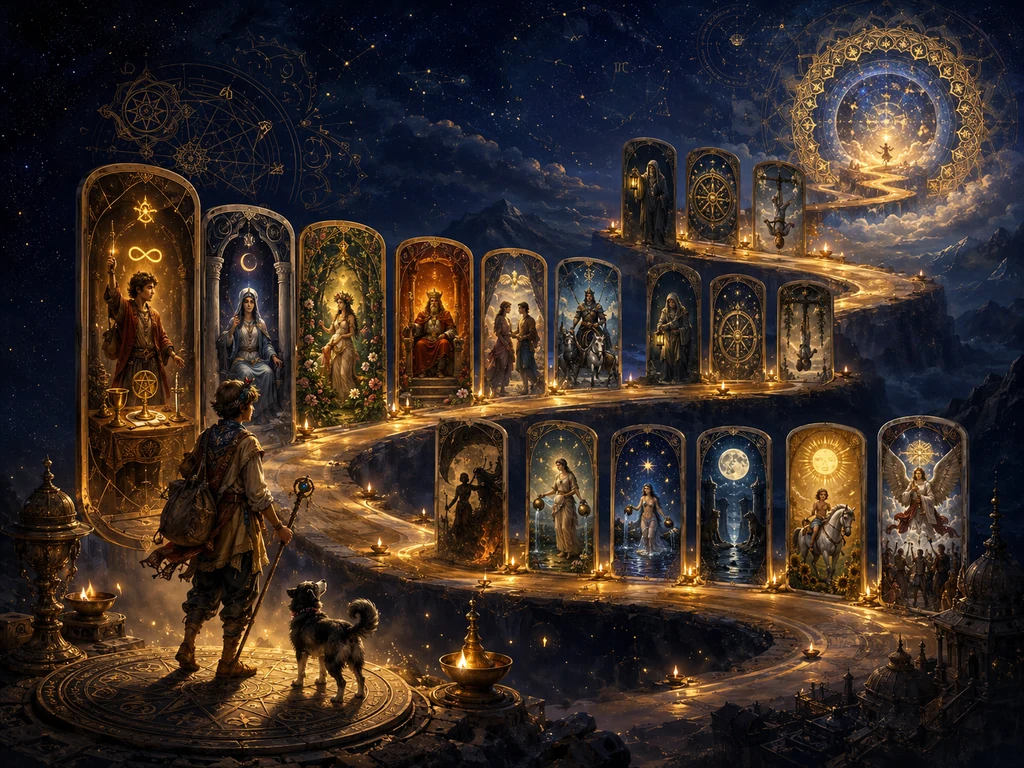
The Fool’s Journey reads all 22 Major Arcana as one symbolic passage from innocence and choice through crisis, insight, integration, and return to life.
The Fool’s Journey is a way of reading the 22 Major Arcana as one continuous story: the Fool begins at 0 in openness and unformed potential, passes through choice, discipline, loss, surrender and awakening, and arrives at 21, the World, with experience integrated rather than innocence destroyed. It is not a promise that every life unfolds in a neat order. It is a symbolic map that helps a reader recognise which stage of development a question, relationship or decision is presently expressing.
What does the Fool’s Journey mean in tarot?
The Fool’s Journey treats each Major Arcana card as a chapter in the formation of a person. The Fool is not merely “someone foolish,” and the World is not simply “success.” The Fool is consciousness before it knows the road; the World is consciousness after it has met the road, been changed by it and learned how to participate in life more fully.
This framework is useful because the Major Arcana can otherwise feel like 22 unrelated images. Read as a sequence, they reveal a rhythm: arrival, education, testing, reversal, breakdown, illumination and return. The journey is less like climbing a staircase and more like moving through a spiral. A person may meet the Lovers in one area of life while living through the Tower in another. Years later, the same card may return at a deeper level.
Historically, tarot did not begin as a single occult biography. Fifteenth-century Italian packs combined 56 suited cards with 21 trumps and a Fool, and the cards were first used for play; their modern divinatory use developed much later. The Metropolitan Museum’s history of tarot’s structure is especially useful here, while the British Museum’s Tarot de Marseille collection record shows how later standardised packs preserve the older 78-card form. The Fool’s Journey is therefore best understood as an interpretive teaching model, not as a documented medieval doctrine.
How do the Major Arcana form one story from 0 to 21?
At 0, the Fool, the traveller stands before experience. There is freedom, but little proof. The card can describe trust, spontaneity, risk, naivety or the beginning of an identity not yet fixed. Its zero matters symbolically: the Fool can precede the sequence, move through it, or begin again after the World.
With I, the Magician, potential becomes directed action. The traveller discovers will, language, skill and the ability to combine available resources. II, the High Priestess immediately corrects the Magician’s outward confidence by introducing silence, receptivity and knowledge that cannot be forced. Together they establish a fundamental tension in tarot: act, but also listen.
III, the Empress brings growth, embodiment, nurture and abundance. Life is no longer an idea; it must be fed. IV, the Emperor gives that life structure, boundaries and continuity. V, the Hierophant places the individual inside inherited systems: family codes, education, religion, custom, mentorship and social permission. These three cards show how raw potential becomes cultured, protected and instructed.
At VI, the Lovers, the traveller encounters choice through relationship. The card concerns attraction, but its deeper subject is alignment: what will you unite with, and what will that choice make of you? VII, the Chariot follows because a choice needs direction. Desire must be gathered into movement; conflicting impulses must be held strongly enough to travel together.
In the Rider–Waite–Smith order, VIII, Strength, teaches that force is not the same as mastery. Instinct is not defeated but related to. IX, the Hermit, then withdraws from noise to find an inner standard. The Chariot proves that one can move; Strength and the Hermit ask whether movement is governed by courage and discernment.
X, the Wheel of Fortune, introduces forces larger than personal intention. Circumstances turn, advantage changes hands and life refuses to remain controllable. XI, Justice, asks what follows from choice: proportion, accountability, evidence and consequence. Some Marseille traditions number Justice VIII and Strength XI, so a careful reader should follow the deck in hand rather than treating one modern order as universal.
At XII, the Hanged Man, progress stops. The traveller cannot solve the problem by repeating the previous method. Suspension, sacrifice or reversal of viewpoint becomes necessary. XIII, Death, carries that surrender into irreversible transition. It usually describes an ending, shedding or change of state, not literal physical death.
XIV, Temperance, is the slow art of recombination. After loss, the parts of life do not instantly return to their old arrangement. A new proportion must be discovered. XV, the Devil, reveals what still binds the traveller: appetite, shame, compulsion, dependency, material fixation or a bargain that has quietly become a cage.
XVI, the Tower, breaks the structure that can no longer contain truth. This can be disruptive, but it is not punishment delivered by a hostile universe. It is exposure. What was concealed becomes impossible to ignore. XVII, the Star, follows not as instant triumph but as honest recovery: simplicity, hope, openness and the first clean breath after collapse.
XVIII, the Moon, warns that healing does not remove uncertainty. Memory, fear, dream, projection and intuition mingle in dim light. XIX, the Sun, clarifies what the Moon obscured. It brings vitality, recognition, warmth and the relief of seeing plainly. Yet the Sun is not childish positivity; it is truth that can survive visibility.
At XX, Judgement, the traveller hears a call that cannot be answered by returning to the old identity. The card is about reckoning, awakening and response. XXI, the World, completes the arc through integration. The traveller belongs to life with greater range, but completion is not permanent stasis. The World contains the threshold of another Fool.
“The Major Arcana do not predict a straight road; they show how consciousness meets choice, consequence, surrender and return.”
How do you read the Fool’s Journey in a tarot spread?
Do not force every spread into chronological order. First read the actual position of the card: obstacle, advice, past influence, likely development, hidden factor or outcome. The journey adds a second layer by showing the kind of chapter the card belongs to.
A card from the early sequence often concerns formation: learning to act, trust, choose, relate or establish authority. A middle card frequently tests the structures already built. A later card tends to describe transpersonal pressure, revelation, reckoning or integration. This is not a rigid hierarchy in which later cards are “better.” The Devil may be more useful than the Sun when the real need is to admit dependency; the Hanged Man may be healthier than the Chariot when effort has become avoidance.
The distance between cards can also speak. Magician followed by Chariot suggests rapid mobilisation of skill. Chariot followed by Hanged Man suggests that determined movement reaches a necessary pause. Tower followed by Star describes recovery after exposure. Star followed by Moon may show hope present, but not yet free of projection.
When several Major Arcana appear, the reading usually concerns a chapter with lasting psychological or spiritual weight rather than a minor daily fluctuation. When only one appears among many Minor Arcana, it often acts as the organising principle beneath practical events. For the grammar of suits, elements and everyday circumstances, use the separate guide to the [four suits of the Minor Arcana] rather than making the Major Arcana carry every detail.
Reversals should not be treated as automatic negations. A reversed card may indicate delay, internalisation, excess, resistance or a lesson being lived privately. The method is covered more fully in [what reversed tarot cards mean].
What does a worked Fool’s Journey reading look like?
Consider a three-position spread for the question, “Why has my career stalled, and what is the next constructive move?” The positions are current condition, necessary shift and emerging direction. The cards drawn are VII the Chariot, XII the Hanged Man and XVII the Star.
The Chariot in the current-condition position shows a person who has relied on drive, output and self-command. The problem is not laziness. It is over-identification with forward motion. The card says, “I know how to push,” but it may also reveal that pushing has become the only available strategy.
The Hanged Man in the necessary-shift position is concrete: stop trying to solve the stall through more acceleration. A pause, changed metric or voluntary surrender of control is required. In practice, this could mean suspending an aggressive application cycle for two weeks, requesting candid feedback, or relinquishing a role title that no longer fits. The card does not ask for passive resignation; it asks for a different angle of participation.
The Star in the emerging-direction position shows what becomes possible after that surrender. It favours honest rebuilding, renewed confidence and work that feels less defended. The sequence matters. Chariot to Star without the Hanged Man would suggest straightforward progress. Chariot to Hanged Man to Star says hope returns because the old mode is interrupted.
A responsible reader would not convert this into “You will get a job in seventeen days” merely because the Star is XVII. The useful counsel is behavioural and observable: pause the compulsive push, obtain new information, simplify the aim, then re-enter the search from a clearer centre.
Can the Major Arcana tell timing?
Tarot can describe sequence more reliably than calendar time. A card may show what must occur before another development becomes available, but card numbers do not create a universal timetable. The Hermit does not automatically mean nine days, the Tower does not guarantee an event on the sixteenth, and the World does not promise completion in twenty-one weeks.
Timing becomes more credible when the spread defines a period in advance, such as “the next six weeks,” and when the reader uses positions that distinguish early, middle and later phases. Repetition across separate readings may confirm emphasis, but repeatedly asking the same question often produces noise rather than precision.
Some modern schools add astrological, elemental or seasonal correspondences. Those systems can be coherent within their own rules, but they are later esoteric overlays and should not be presented as universally ancient. For date-specific Vedic timing, a kundli analysis uses planetary periods and transits, not tarot card numbers.
How is the Fool’s Journey different from Vedic astrology?
Tarot and Jyotisha can both support reflection, but they do not share the same textual foundation. Brihat Parashara Hora Shastra (BPHS), Phaladeepika, Saravali and the Jaimini Sutras discuss planets, signs, houses, yogas, planetary periods and related astrological principles; they do not teach the Major Arcana or the Fool’s Journey.
From the practitioner’s chair, mixing the systems carelessly creates false authority. A tarot reader should not claim that the Tower “is a Parashari rule,” and a jyotishi should not replace dasha analysis with a card draw. When both are used, let astrology address natal structure and time cycles, while tarot explores the lived question, the person’s stance and the choice available now. A personal report or consultation with an experienced astrologer should make the method being used explicit.
A useful Sanskrit word here is saṃskāra, an ingrained pattern left by repeated experience. Tarot can help name an ingrained pattern, but naming it is not the same as proving a future event. That distinction protects both the client and the integrity of the reading.
What should you do when a difficult Major Arcana card appears?
Translate the image into a question before translating it into a prediction. With Death, ask what has already ended but is still being carried. With the Devil, ask where consent, appetite or fear has narrowed choice. With the Tower, ask which fact would reorganise the situation if fully admitted. With the Moon, ask what remains uncertain and what evidence is missing.
Then move from symbol to proportionate action. A card can justify reflection, a conversation, a boundary, a pause or a request for professional help. It should not justify reckless financial decisions, medical self-diagnosis, legal conclusions or accusations against another person. Tarot is strongest when it clarifies participation, not when it pretends to replace evidence.
The same principle applies to favourable cards. The Sun is not permission to ignore risk. The World does not mean every matter is permanently resolved. The Star supports hope, but hope still needs a practice.
Is the Fool’s Journey a fixed sequence everyone must live?
No. It is a symbolic sequence, not a compulsory biography. People revisit cards, skip apparent stages, or live several at once. A teenager may face a Tower-like family upheaval before having developed Emperor-like stability. An accomplished adult may return to the Fool when beginning a new vocation.
The model becomes harmful when it is used to rank people as “more evolved” or “stuck on a lower card.” Tarot archetypes describe situations and modes of consciousness; they are not a caste system of spiritual worth.
Does drawing the World mean the journey is over?
The World indicates integration, completion, participation and a widened field of belonging. In a bounded question, it can show that a cycle is ready to close. In a life reading, it rarely means that growth has ended. Completion frees energy, and that freedom often produces another Fool-like beginning.
The most mature reading of the World includes both achievement and release. A finished identity may deserve celebration, but it must also be allowed to become history.
Is the Fool always a positive card?
No. The Fool can be liberating when caution has become paralysis, but careless when enthusiasm ignores consequence. Its value depends on position, question and surrounding cards. Fool with the Magician may show inventive initiative; Fool with the Devil may expose impulsiveness captured by appetite; Fool with Justice may require a careful look at responsibility before the leap.
The card asks for openness, not the abandonment of judgement.
Can one Major Arcana card describe an entire year?
It can serve as a reflective theme for a year, but not as a complete forecast. One card may identify the central developmental question, while actual events still depend on circumstance, choice and, in astrological practice, the natal chart and current planetary periods.
Use a yearly card as a lens: notice how its pattern appears, what it asks you to practise, and where its shadow emerges. Do not let it become a sentence imposed on every event.
What is the deepest lesson of the Fool’s Journey?
The journey does not teach that innocence must be punished before wisdom is earned. It teaches that potential becomes meaningful through encounter. The Fool learns to act through the Magician, to receive through the High Priestess, to choose through the Lovers, to accept consequence through Justice, to surrender through the Hanged Man, to release through Death, to face bondage through the Devil, to endure truth through the Tower and to rejoin life through the World.
Its deepest movement is from unconscious freedom to conscious participation. The final card does not erase the first. The World contains the Fool’s openness, but now openness has memory, discernment and responsibility.
Tarot and astrology are tools for guidance and reflection, not substitutes for medical, legal or financial advice. Read the Major Arcana as a language of pattern and choice, and the Fool’s Journey becomes neither fortune-telling theatre nor a rigid spiritual ladder, but a disciplined way to ask where you are, what this chapter requires and what kind of person may emerge from meeting it well.