Four Suits, Four Elements: A Beginner’s Minor Arcana Map
Learn how Wands, Cups, Swords and Pentacles map to fire, water, air and earth—and how suit, number and court cards combine in a clear tarot reading today.
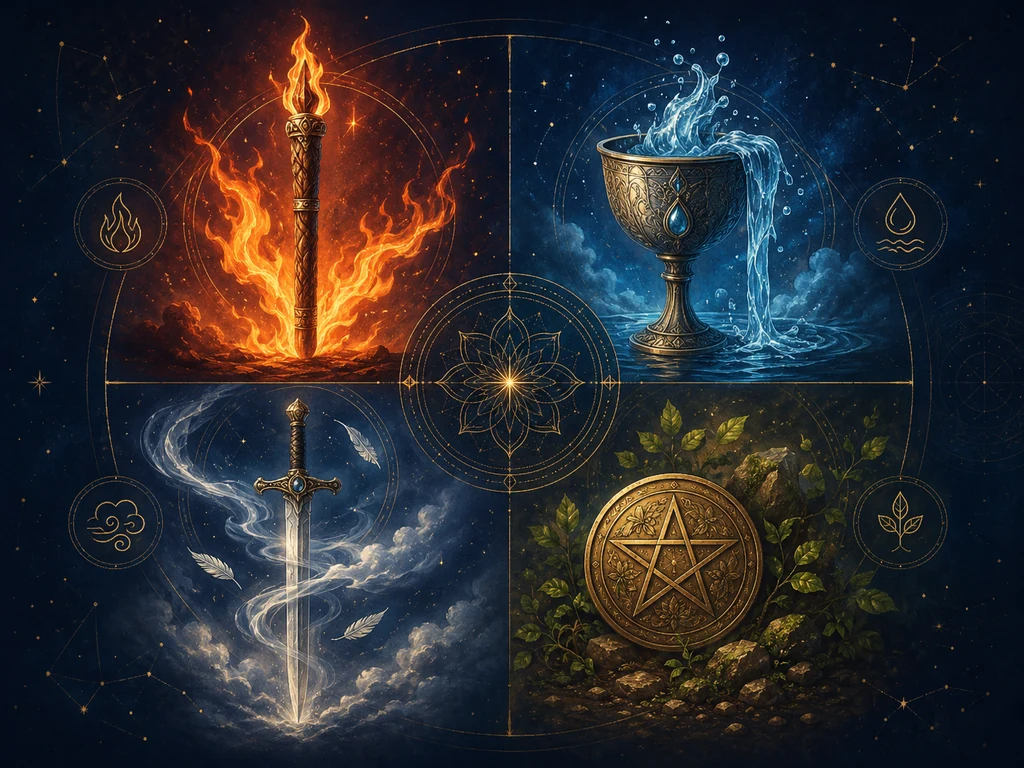
The four Minor Arcana suits are a practical map of ordinary life: Wands correspond to fire and action, Cups to water and feeling, Swords to air and thought, and Pentacles to earth and material reality. Read the suit as the life area or mode of experience, then let the card’s number, court rank, image and spread position show what is happening within it. The element is not a verdict; it is the card’s operating language.
What are the four Minor Arcana suits?
A standard tarot deck contains 56 Minor Arcana cards arranged into four suits of 14 cards each. Every suit runs from Ace to Ten and then through four court cards, usually Page, Knight, Queen and King. The suit describes the kind of energy involved, while the number or court rank describes its stage, behaviour or level of maturity.
The suits descend from the older Italian symbols of batons, cups, swords and coins. Historical tarot began as a card game; its explicit occult framework developed later. The Metropolitan Museum of Art’s history of tarot is useful because it separates the fifteenth-century card structure from later fortune-telling. The familiar fire, water, air and earth correspondences are therefore an interpretive system, not a rule printed into the earliest decks.
In Sanskrit, an elemental principle may be called a tattva. The resemblance is useful, but it should not be overstated. Tarot’s four-element map belongs to Western esoteric practice. Brihat Parashara Hora Shastra, Phaladeepika and Saravali teach judgement through planets, signs, houses, aspects, strengths and periods; they do not teach Minor Arcana correspondences. A practitioner may combine tarot and Jyotisha, but should not present “Wands equals Mars” or “Cups equals Moon” as a classical Parashari rule.
What does the Wands suit mean?
Wands are fire: initiative, courage, momentum, creativity, sexuality, competition and the urge to begin. In career readings they can show ambition or a project needing energy; in relationship readings they may show attraction, pursuit or impatience. In health-related reflection they may describe vitality or overexertion, but they cannot diagnose a condition.
Fire is not automatically positive. Too little can look like hesitation; too much can become haste, conflict or burnout. The Five of Wands may show useful friction or competing priorities, while the Ten of Wands can indicate competence pushed into overload. When Wands dominate, ask where speed is helping and where it is replacing judgement.
What does the Cups suit mean?
Cups are water: emotion, relationship, memory, imagination, empathy, pleasure and spiritual longing. They frequently appear in love readings, but they also cover friendship, family bonds, grief, artistic sensitivity and belonging.
Water takes the shape of its container, so Cups are especially sensitive to context. The Two of Cups may show romantic, professional or therapeutic agreement. The Four of Cups may be apathy, protection or a wise refusal. The Seven of Cups can show imagination and options, yet also projection when feeling outruns evidence. Many Cups do not guarantee happiness; they show that emotion is carrying much of the situation.
What does the Swords suit mean?
Swords are air: thought, language, analysis, decisions, truth, conflict, law and strategy. Beginners often fear the suit because several images are severe, but air also gives discernment and the capacity to name what is happening.
Its shadow is mental overactivity. Planning can become rumination and honest speech can become cruelty. The Eight of Swords may show restriction maintained partly by untested assumptions. The Ace of Swords can be a breakthrough or firm decision; the Four may advise deliberate rest. When Swords dominate, examine communication, contracts, competing interpretations and beliefs that have not been verified.
What does the Pentacles suit mean?
Pentacles are earth: money, work, body, skill, home, time, tools and anything maintained in the physical world. They may concern salary, but also sleep, craftsmanship, routine, caregiving or the slow accumulation of competence.
Earth’s virtue is reliability; its shadow is inertia or control. The Four of Pentacles may show prudent conservation or fear-based holding. The Eight can indicate disciplined learning, but also repetitive work without direction. The Nine often speaks of earned independence rather than sudden wealth. Many Pentacles bring the question down to logistics: cost, routine, responsibility and sustainability.
“The suit tells you what kind of world the card is operating in; the number and image tell you what that world is doing now.”
How do numbers change the meaning of each suit?
The number gives the suit a developmental stage. Aces are concentrated beginnings. Twos introduce polarity, choice or exchange. Threes expand through expression and cooperation. Fours stabilise or contain. Fives disturb the existing order and reveal pressure points.
Sixes seek adjustment after the Five. Sevens test conviction. Eights intensify process through movement, skill, restriction or organised effort. Nines approach culmination. Tens complete a cycle, which may feel like fulfilment, excess, inheritance or burden.
This sequence is a reading aid, not a machine. The Three of Swords does not mean cheerful “growth in thought”; its image focuses the threefold principle through painful recognition. The Three of Pentacles, by contrast, develops through coordinated skill. Number, suit and scene must be read together. For the larger distinction, see Major Arcana and Minor Arcana explained.
How do court cards work in a tarot reading?
Court cards can describe a person, role, behaviour or maturity of an element. Pages learn and carry messages. Knights pursue and test the suit through movement. Queens tend to embody it inwardly through self-possession. Kings direct it outwardly through standards and responsibility.
These ranks are not fixed genders or ages. A Queen of Swords can describe any person using clear boundaries. A Knight of Cups may be a charming individual, an invitation or the part of the querent that follows an ideal too quickly. A Page of Pentacles may be a student, a new financial plan or the willingness to practise.
A useful test is grammatical. If the card behaves like a noun, it may be a person or role. As a verb, it may show what someone is doing. As an adjective, it may describe the tone required: patient, direct, receptive or bold.
How do you read suit balance in a spread?
Begin with the question and spread position, not a memorised keyword. A card in “what helps” should not be read exactly like the same card in “what obstructs.” Then notice the image, suit and rank before comparing neighbouring cards and the elemental balance.
A spread heavy in Wands may call for action or warn that everyone is acting at once. Many Cups can reveal emotional importance or flooding. Many Swords may show difficult dialogue, documents or overthinking. Many Pentacles may indicate practical construction, financial pressure or patience.
A missing suit is quieter evidence. No Cups in a relationship spread does not prove love is absent; perhaps logistics or communication currently dominate. No Pentacles in a business spread may suggest that budgets and operations remain undefined. Absence is a prompt, not a verdict.
Reversals are optional. A reversed card may show blocked, internalised, delayed or excessive expression rather than the exact opposite of its upright meaning. This is covered separately in what reversed tarot cards really mean.
How do you combine Minor Arcana with a kundli?
Treat the methods as distinct instruments. A janam kundli can describe natal structure, planetary periods and transit activation. Tarot can clarify the present question, the querent’s stance, available choices and the pattern forming around a decision. One should not counterfeit precision in the other.
If a chart shows a demanding career period, tarot can ask whether the immediate issue is a Wands problem of overload, a Cups problem of morale, a Swords problem of contracts or a Pentacles problem of salary and workload. The chart establishes the larger terrain; the cards articulate how it is being encountered now.
Classical Jyotisha insists on synthesis. BPHS and Saravali do not support judging a life from one isolated placement, and the same discipline improves tarot. One card should not overrule the spread. For time-sensitive astrological context, use the current horoscope and transit overview, while keeping the tarot message anchored to the cards.
Worked example: Moon at 18° Aquarius with a three-card spread
Consider a client asking, “Should I accept a new role if the offer arrives within six weeks?” Their Moon is at 18° Aquarius, in Shatabhisha, fourth pada. That placement alone cannot decide the outcome; house, aspects, dignity, dasha and the Moon’s dispositor are all necessary. It does, however, suggest a tendency to process feeling through analysis, distance and systems.
The cards are Eight of Swords for the present, Ace of Wands for the best action and Three of Pentacles for the likely development. The Eight of Swords describes feeling mentally cornered, perhaps by treating incomplete information as a fixed limitation. The Aquarian Moon can reinforce the wish to solve every future variable before acting.
The Ace of Wands advises initiative: request the written role, reporting line, deadline and authority instead of waiting passively. The Three of Pentacles says the opportunity becomes real through collaboration, skill recognition and a workable team. It is an earth card, so enthusiasm must become process.
The answer is conditional: pursue the offer, but accept only when the team structure and expectations are explicit. Fire makes the opening quick; earth makes successful settlement slower. Within six weeks, this suggests prompt movement followed by adjustment, not instant certainty. For a high-stakes decision, the reader should also examine dasha and transits or refer the client to qualified astrologers.
When do Minor Arcana cards indicate timing?
Tarot timing is approximate because no single timing system is universal. A practical elemental method treats fire as fastest, air as quick but changeable, water as dependent on emotional or relational development, and earth as slowest because material conditions take time. These are conventions, not guarantees.
The number refines timing only when the question supplies a unit. In a ten-day question, a Three may indicate the third day or an early phase; in a six-month question, it may indicate the third month. Do not announce “three days” merely because a Three appears.
Court cards often time through people rather than dates: movement occurs when a manager responds, a learner completes training or a responsible person takes charge. Astrological correspondences attached to tarot vary by school and should be used only when the deck’s system is known. No special 2026 transit date is required to understand the four suits.
What should you do after a Minor Arcana reading?
Translate each element into a grounded question. With Wands, identify the next action and the cost of haste. With Cups, name the feeling without treating it as proof. With Swords, separate facts, assumptions and required conversations. With Pentacles, specify the resource, habit, budget or deadline that makes the answer real.
Then reduce the reading to one conditional sentence. “Move forward once the agreement is written” is better than “The cards say yes.” Conditions preserve agency and make the reading testable.
Record the question, cards and interpretation before the outcome is known. Reviewing it later exposes where the reading was accurate, where anxiety distorted it and where a favourite keyword was forced onto the wrong context.
What myths confuse beginners about the four suits?
No suit is wholly fortunate or unfortunate. Wands can create or burn out. Cups can nourish or idealise. Swords can wound or clarify. Pentacles can stabilise or imprison through fear of loss. The element describes a mode of experience, not moral value.
Nor does each suit belong to only one department. Pentacles are not only money, Cups not only romance, Wands not only career and Swords not only conflict. Work, love and family can each involve all four elements.
Deck systems also vary. Some rename suits as staffs, chalices, blades or disks, and some esoteric traditions alter correspondences. Read the guidebook and symbolic logic of the deck in your hands. For the influential Rider–Waite–Smith system, consult A. E. Waite’sThe Pictorial Key to the Tarot, illustrated by Pamela Colman Smith.
Tarot is for guidance and reflection. It is not a substitute for medical diagnosis, legal counsel or financial advice, and no frightening card should be used to pressure a client.
Which Minor Arcana suit represents love?
Cups most directly describe emotional exchange and intimacy. Yet a lasting relationship also needs Wands for desire, Swords for communication and Pentacles for reliability. A spread full of Cups can feel romantic while still lacking practical commitment.
Which Minor Arcana suit is the strongest?
None is inherently strongest. Strength depends on the question, position and balance of the spread. The Ace of Pentacles may matter more than the Ace of Wands when the client needs a concrete offer; the Ace of Swords may matter most when the problem is ambiguity.
What does it mean when the same suit keeps appearing?
Repeated suits show that one mode of experience dominates the issue. Repeated Swords may mean the situation is being met through thought and language; repeated Pentacles may reveal that practical security is the real concern beneath an emotional question. Repetition gives emphasis, not fate.
Can you read the Minor Arcana without astrology?
Yes. Tarot is a complete symbolic method and does not require a birth chart. Astrology can add context when the practitioner is trained in both systems, but a clear question, defined spread and consistent interpretation are enough.
Should beginners use reversed Minor Arcana cards?
They may, but they do not need to. Upright cards already contain constructive and difficult expressions, and spread positions can show whether an energy helps or obstructs. Beginners often learn faster by reading upright cards deeply before adding reversals.